

The fundamental flaw in compliance and data integrity is not technology, it is the assurance of that technology.
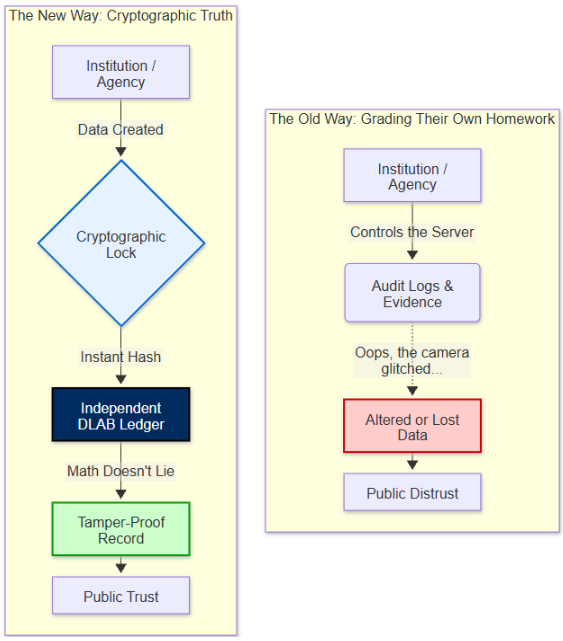
Across the global economy, we rely on a broken governance model, we allow institutions to grade their own homework. Whether it is a Fortune 500 bank self-reporting to the OCC, a defense contractor attesting to CMMC controls, or a municipality managing its own surveillance logs, the system relies on retroactive, point-in-time audits.
This creates a massive trust deficit, billions in deadweight compliance costs, and an environment conducive to error and fraud.
We cannot legislate human nature, and we cannot audit our way to the truth 90 days after the fact. We require a transition from human attestation to Continuous Cryptographic Compliance (CCC) supported by human assurance/audits.
The Governance Wall
The apex players in risk and defense already know this.
In 2020, the Department of Defense explored Distributed Ledger Technology (DLT) to achieve continuous compliance across the defense industrial base. Simultaneously, Big 4 firms like Deloitte have published internal audit literature on deploying “auditor-node technology” to observe blockchains in real-time.
They have the right math, but they have hit a governance wall.
Deloitte wants to put an auditor node on a client’s private blockchain but a private blockchain lacks regulatory trust. The DoD wants a secure ledger but if the Pentagon centralizes it, it creates a massive attack surface and creates the question of “who watches them?”.
The roadblock isn’t cryptography. It is the absence of a federated governance model. To solve this, we must elevate the architecture and establish what I’m calling a Distributed Ledger Assurance Board (DLAB).
The DLAB Architecture
DLAB functions as an equivalent of the PCAOB (Public Company Accounting Oversight Board). DLAB does not touch the data, it defines the operational and cryptographic standards for the baseline of the network.
Under this framework, the nodes are not run by anonymous crypto-miners, nor are they run by the government. They are operated by Regulated Node Stewards, perhaps Big 4 accounting firms, C3PAOs, and other large services providers. The understanding is, like the financial audit, if you audit it, you cannot operate it.
This creates a strict Separation of Duties (1LOD vs. 3LOD) powered by a new integration standard: Extract, Hash, Load (EHL).
The Feeder Node (1LOD): An enterprise integrates its internal systems (ERP, IAM, EHR) with a local Feeder Node. When a critical control fires, the node does not send the raw data. It generates a cryptographic hash of the event and writes it to the ledger in real-time.
The Reader Node (3LOD/Regulator): Regulators (OCC, FDA, DoD) operate Reader Nodes. They do not issue 90-day data requests. They query the ledger. The hash mathematically proves the control was executed at the exact timestamp claimed, and that the data has not been retroactively altered. Minimizing the complexity and time required to prove compliance.
The Vertical Strikes: Determinism vs. AI
Right now, corporate boards are blinded by the AI hype cycle. But AI is probabilistic, it guesses, it hallucinates, and it requires human oversight. DLAB is deterministic, it mathematically proves, it locks, and it enhances the quality of human oversight.
AI accelerates the writing of the compliance report. DLAB eliminates the need for the report entirely.
When we deploy this architecture across critical sectors, the productivity gains outstrip anything AI can deliver:
1. Defense (CMMC) & The N-Tier Supply Chain
Currently, Prime Contractors have zero visibility into Tier-4 subcontractors. Under DLAB, C3PAOs operate the Assurance Nodes. A small machine shop streams hashed telemetry (e.g., MFA enforcement) to the ledger. If the shop’s compliance hash fails, a smart contract physically blocks the transfer of Controlled Unclassified Information (CUI) to that vendor. We replace $80,000 manual audits with algorithmic enforcement.
2. Life Sciences & The Zero-Trust FDA Submission
Proving data integrity to the FDA costs pharmaceutical companies billions in delayed time-to-market. By hashing clinical trial telemetry and cold-chain IoT sensor data directly to a DLAB ledger, the FDA no longer spends months auditing the integrity of the data. The ledger mathematically proves it is pristine, accelerating drug approvals by months.
3. Financial Services & Eradicating the MRA
Banks spend up to 10% of their operating revenue on compliance fire drills. By streaming IAM and vulnerability management hashes to a Feeder Node, it becomes nearly impossible for the OCC or FDIC to issue an MRA (Matter Requiring Attention) for “lack of evidence.” The evidence is cryptographically immutable and continuously streamed to the regulator’s own node.
The Economic Reality
The Big 4 and global systems integrators are driven by quarter-to-quarter profit mandates and equity payouts. The sheer volume of tactical transformation required to build these Feeder Nodes, establish the EHL pipelines, and operate the Assurance Nodes will trigger a consulting gold rush. That translates into thousands of high paying jobs.
They will not be able to ignore the participation and profit of that transformation any more than they are able to ignore AI.
The Future of Risk
We are operating in a zero-trust society. We can no longer rely on institutions to grade their own homework, and we cannot solve a mathematical trust deficit with more political policies and parties.
DLAB is not just a cybersecurity framework. It is the architectural blueprint for restoring societal and economic trust in an objective manner.
Mr. Smith is a Cybersecurity Risk Management Consultant specializing in enterprise risk architecture, continuous compliance, and advisory engagements. Schedule a call to discuss this further.