
American healthcare should not be an ideological playground.
It is the largest, most expensive, and most fragile operational system in the modern world. Consuming nearly one-fifth of our entire economy, it touches every corporate balance sheet, municipal budget, and family kitchen table in the country.
Yet, our political leaders treat it like a bumper sticker.
The progressive extreme insists that a simple legislative stroke labeled “Medicare for All” will deliver completely free, unlimited care to everyone overnight, funded entirely by taxing a handful of billionaires.
The conservative extreme dismisses the crisis entirely, repeating the comfortable talking point that “America has the best healthcare system in the world” and warning that any structural change will destroy our freedom.
Meanwhile, this crisis never goes away. It was a battleground under Truman and Nixon, an emergency under Clinton, Bush, Obama, Trump, Biden, and it remains one today.
Why hasn’t this been solved?
Because for more than eighty years, politicians and powerful special interest lobbies have found it more profitable to keep the system broken. Let’s call those lobbies out by name:
Commercial Insurance Giants: Entities that extract massive margins by designing confusing, restrictive networks and hiring armies of administrators whose primary job is finding reasons to deny claims.
Consolidated Hospital Monopolies: Multi-hospital conglomerates—many owned by private equity—that buy up local family practices, shut down competition, and use secret contract clauses to charge exorbitant, non-negotiable prices.
Pharmaceutical Manufacturers: Drug companies that spend billions lobbying Washington to protect patent “evergreening”—making minor chemical tweaks to existing drugs purely to reset their 20-year monopoly clocks—while directing research capital toward high-margin cosmetic products rather than critical cures.
Pharmacy Benefit Managers (PBMs): The opaque, unregulated middlemen sitting between drug makers and pharmacies, pocketing billions in undisclosed rebates while inflating the out-of-pocket prices people pay at the counter.
These groups spend billions in Washington to preserve a status quo where costs skyrocket and care becomes harder to access. Actual reform requires deconstructing this machinery, confronting painful trade-offs, and demanding accountability.
Bumper stickers, by contrast, simply raise cash for the next campaign.
Why There Are No Four-Year Miracles
The greatest lie told in American politics is that healthcare can be “fixed” in a single four-year presidential administration.
We did not arrive at this crisis overnight. We spent more than eighty years painting ourselves into this corner:
It began in 1942 when wartime wage freezes led companies to offer tax-free health benefits to compete for scarce labor, accidentally chaining human health to corporate employment.
It was cemented in 1965 when Medicare entrenched the fee-for-service engine, subsidizing procedural volume over health maintenance.
It was fractured in 1974 when ERISA split regulatory authority between corporate self-insured plans and fifty separate state insurance commissioners.
It accelerated over decades through hospital mergers, opaque PBM cartels, and an explosion of administrative paperwork that turned medicine into a billing contest.
American healthcare is carrying eighty years of accumulated legal, economic, and institutional technical debt. Consuming nearly 20% of our GDP and supporting millions of clinical jobs, this machine cannot be overhauled by an executive order or a 100-day legislative blitz.
Anyone selling a quick fix, also trying to sell you the “Brooklyn bridge”.
Untangling an eighty year old, five trillion dollar apparatus requires a migration plan spanning decades, not election cycles. We will have to have the civic maturity to accept that the road ahead is long. But if we do not lay the first structural stones today, our children will inherit an economy completely consumed by healthcare decay.
Operating Principles of This Assessment
As outlined in my foundational post, (About Really Independent / INT-000), every national challenge on this blog is audited through a consistent, disciplined framework:
Respect the Intelligence of the Citizen: Everyday Americans understand basic economics. They know that high-quality services cost money, that nothing in life is truly “free,” and that waste is waste regardless of political branding. We do not need condescending lectures; we need an honest deconstruction of the balance sheet.
Outcomes Over Methods: Partisans argue endlessly over who writes the check—government versus private business. Pragmatists care about functional results: keeping people healthy, preventing treatable deaths, and ensuring timely access without bankruptcy. If a policy fails an honest cost-benefit analysis, it must be replaced.
Fiscal Sustainability is a Hard Reality Check: Math does not care about political promises. When healthcare costs consistently grow twice as fast as the economy supporting it, the system will eventually fail. Policies that bankrupt families and run up national debt to subsidize the current model are non-starters.
The “Mature Republic” Mindset: A mature nation builds a durable, integrated foundation to maintain health rather than lurching from one expensive acute crisis to the next. We must prioritize front-line primary and preventative care over an upside-down system that only rewards reactive, late-stage rescues.
Freedom Requires Accountability: Individual liberty is a foundational American right, but freedom cannot survive if personal choices are permanently divorced from their financial consequences. We must stop structuring our system so that the responsible majority is forced to pay the bill for institutional waste and preventable failure.
The “Best in the World” Paradox
Before examining why the system is failing, we must directly confront the primary argument used to block all reform: the claim that America already has the best healthcare system on Earth.
At the specialized pinnacle of medicine, that claim has a grain of truth to it. If you have a rare cancer, an unlimited corporate health plan, or the wealth to fly to elite academic medical centers like the Mayo Clinic or MD Anderson, the United States offers some of the most extraordinary surgical talent, cutting edge biotechnology, and acute rescue facilities ever created.
However, the healthcare industry can produce medical miracles while the healthcare system fails the majority of its citizens.
For vast numbers of everyday Americans, working families, small business owners, and hourly employees, healthcare is not experienced at the pinnacle of specialized research. It is experienced at the kitchen table: trying to find a doctor accepting new patients, waiting weeks for an appointment, and opening unexpected bills that have the potential to upend the entire household budget.
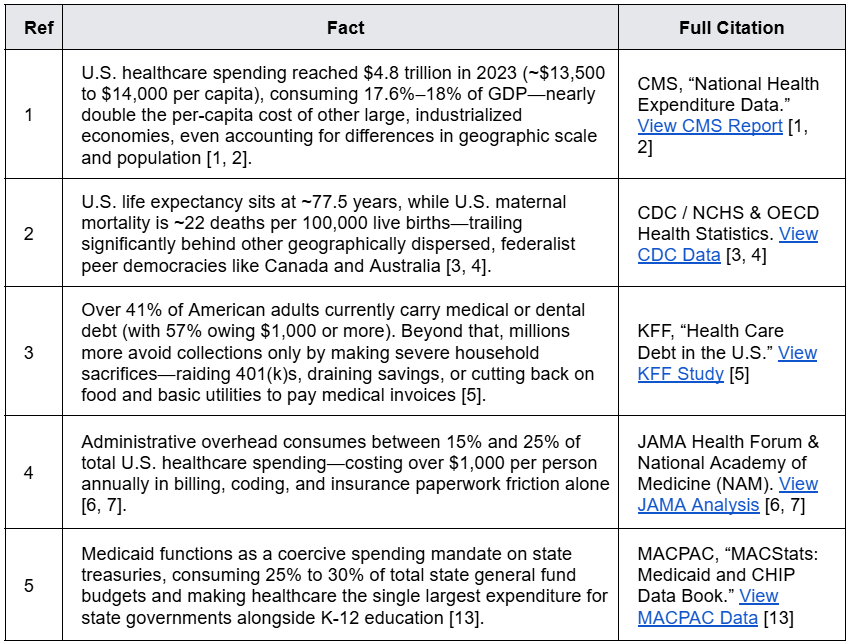
A system must be judged by what it delivers to the median citizen on an ordinary Tuesday. Here are the baseline facts of what our system actually delivers:
Deconstructing the Problem — My Opinion
To understand why American healthcare is failing, you don’t need a degree in economics. You just have to look at two structural traps we have accepted as normal:
First, we allowed human health to be chained to corporate employment.
Most people think their employer is giving them a generous perk by paying for their insurance. In reality, that is your money.
An employer budgets a single total compensation figure for your job. When your company spends $18,000 a year on your family’s health plan, that is cash that could have been in your take-home paycheck as a raise. Tying healthcare to jobs has suppressed American wages for thirty years and turned millions of workers into career hostages—terrified to leave a job they hate or launch their own business because they cannot risk losing their family’s coverage.
Second, health insurance no longer functions as real insurance.
Insurance is supposed to protect your family from financial ruin when disaster strikes. Today, most working families hand over hundreds of dollars from every paycheck for an insurance card that offers very little real protection. When an unexpected medical event occurs, they discover they must pay a $6,000 or $8,000 deductible before the plan pays a dime, while fighting surprise bills from out-of-network providers they never agreed to see.
Responsible families who successfully avoid collections agencies often do so by draining their retirement savings, borrowing from relatives, or skipping basic family necessities just to settle a hospital invoice. People are paying top dollar for coverage, only to face financial devastation when they actually use it.
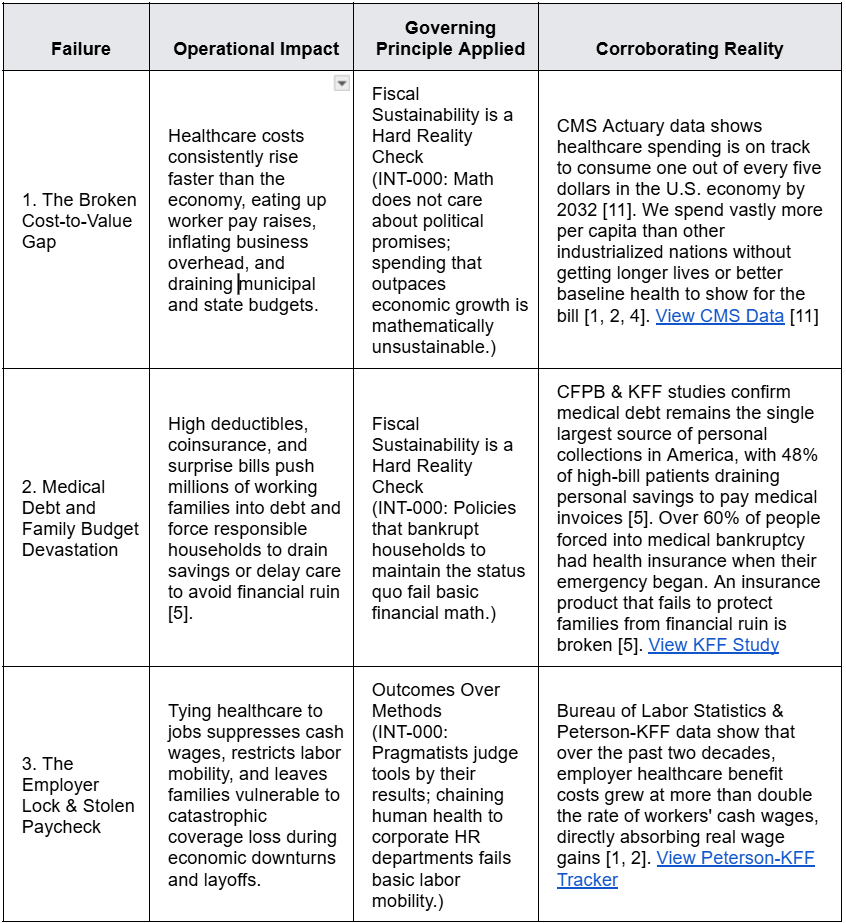
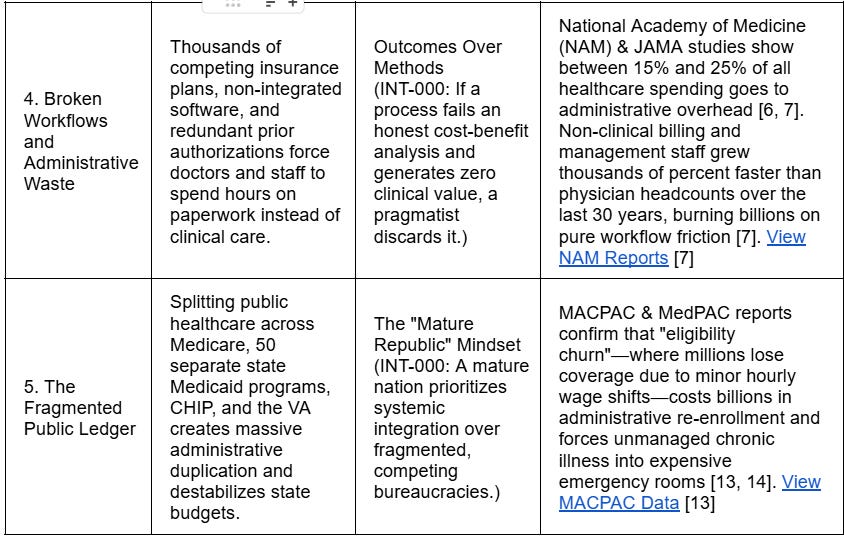
When you look at this through a pragmatic lens, our healthcare crisis is not an unsolvable mystery. It is the direct result of five specific design failures:
Potential Solutions — My Opinion
Before arguing about policy tools, we must define the destination.
Most reform efforts fail because partisans jump straight into ideological warfare over how to pay for care without agreeing on what the system is supposed to accomplish. Any serious healthcare overhaul must be engineered to achieve four non-negotiable objectives:
Universal, Portable Coverage: Every citizen must have continuous, baseline healthcare that belongs to them as an individual—coverage that never terminates or changes because they switch jobs, start a business, or get laid off.
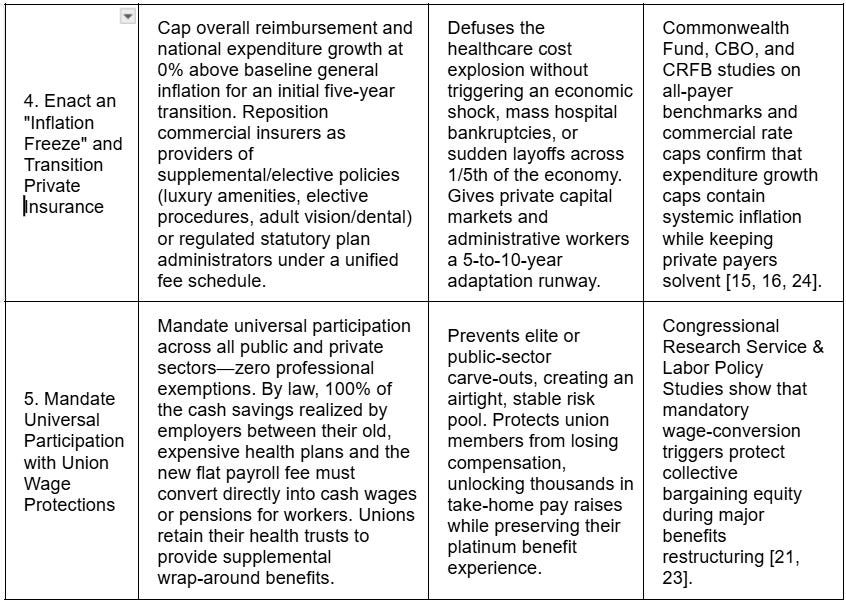
Halt Healthcare Cost Inflation: We must stop the runaway cost escalation that outpaces wages and the general economy. The immediate operational win is an inflation freeze: holding net expenditure growth to 0% above baseline general inflation.
Independent, Stable Governance: Healthcare accounts for 20% of our economy. It requires a permanent, independent governing body insulated from two-year partisan election cycles, with strict checks and balances preventing technocratic overreach.
Transparent, Multi-Pillar Funding: Funding must be financially sustainable for both the public treasury and working families. That means predictable individual contributions, employer payroll parity, and closing the remaining fiscal gap without bankrupting future generations.
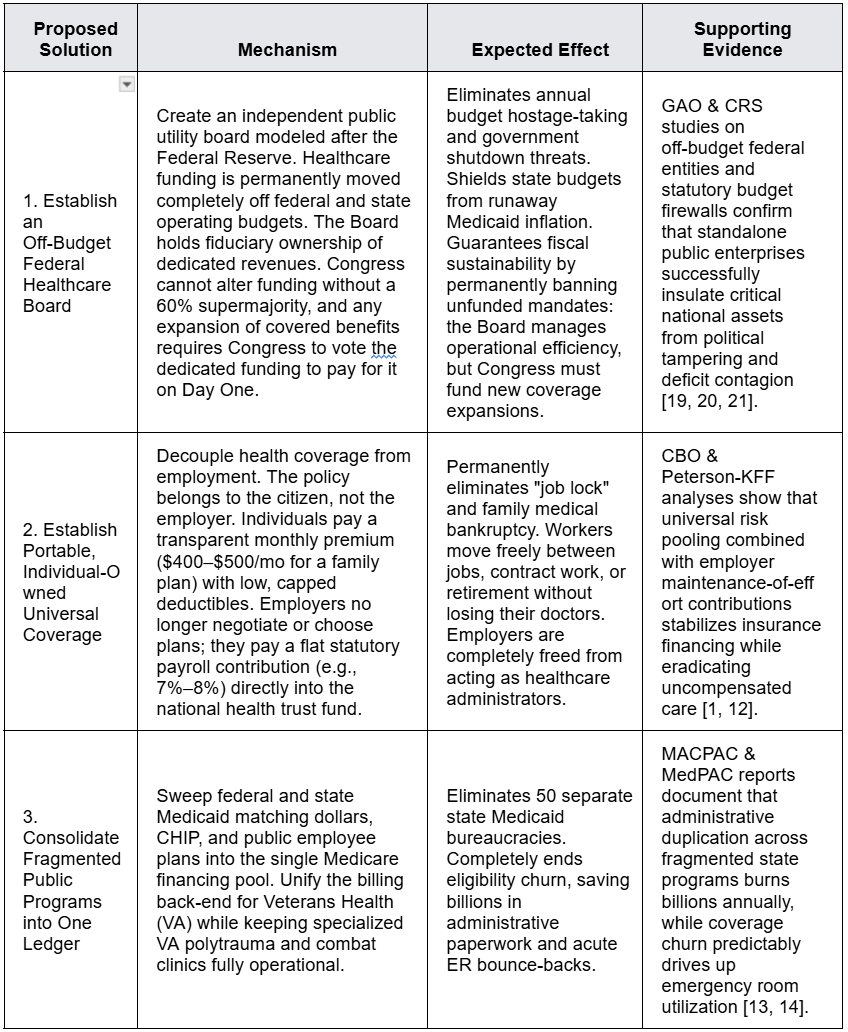
The table below outlines the high-level operational pillars required to achieve these goals:
Governance & Financial Sustainability
If you want to understand why healthcare reform always dies in Washington, look at how both political extremes treat governance, math, and the economy. Both sides sell fiscal fantasies, both hide from accountability, and both completely ignore what their slogans would actually do to American workers and the health of us all.
Healthcare is not an abstract policy thought experiment on a university chalkboard. It accounts for nearly one-fifth of the entire U.S. economy and is the single largest employer in the nation. In thousands of American cities and rural counties, the local hospital network is the primary economic anchor keeping the community alive.
The progressive extreme treats healthcare as an emotional abstraction where basic arithmetic and economic dependencies cease to exist. They promise an overnight transition to “Medicare for All,” with zero premiums, zero deductibles, and slashing hospital revenues to existing Medicare rates, all supposedly paid for by taxing a handful of billionaires.
They never answer the hardest operational question:
What happens to the single mother with a stable, good-paying middle-class life as a hospital nurse, who now finds herself unemployed because her community hospital went insolvent due to Medicare reform revenue cuts?
This is not a hypothetical fear; it is hard financial math. According to the American Hospital Association (AHA) and healthcare financial audits by Kaufman Hall, labor costs account for 56% to 60% of total hospital operating expenses, totaling over $1 trillion annually [22]. Furthermore, MedPAC data confirms that Medicare currently reimburses hospitals at an average of 83 cents on every dollar of actual care delivered [14].
Hospitals survive today solely because commercial private plans pay 200% to 250% of cost to cross-subsidize that public shortfall. Commercial insurers are actively fighting that markup right now which is leading to contract cancellations, dropped hospital networks, and administrative friction that pushes consumer deductibles even higher.
If you slash hospital revenues to existing public rates overnight without a multi-year transition plan, that 60% labor line item gets hit immediately. You trigger a nationwide economic disaster: mass layoffs of nurses, medical techs, and clinic staff, and the immediate closure of neighborhood community hospitals.
Ideologues promise universal care on paper, but deliver pink slips in reality.
The conservative extreme hides behind an equally destructive myth: the fiction that we have a functional “free market” that simply needs less government oversight. There is no free market in healthcare. What we have is an opaque, government subsidized cartel where private equity backed hospital monopolies set prices, Pharmacy Benefit Managers (PBMs) pocket billions, and insurance conglomerates deny care to boost quarterly earnings.
When conservatives shout “Socialism!” to block any structural reform, or push to arbitrarily gut Medicaid and public funding, they produce the exact same human tragedy. Rural hospitals shutter, community clinics vanish, and working-class families lose both their healthcare access and their town’s primary employer. Defending an unregulated monopoly that drives working families into bankruptcy is not a defense of freedom; it is simple political cowardice.
Real reform requires rejecting both extremes. We cannot afford a reckless, overnight revolution that throws millions of healthcare workers out of their jobs, and we cannot afford to protect a corrupt status quo that consumes 18% of our GDP and eats family paychecks alive.
We must govern healthcare not as a political entitlement, and not as an unchecked corporate monopoly, but as an independent, off budget public utility built on five structural pillars:
1. The Independent Board: Insulating Health from the Two-Year Election Cycle
Healthcare accounts for 20% of the U.S. economy. It is far too large, complex, and vital to human life to be managed by politicians in Congress whose primary job is raising campaign cash every 24 months.
We don’t manage monetary policy through congressional committee votes because a modern economy would collapse if politicians voted on interest rates based on polling data. Healthcare requires that exact same operational independence.
Under this model, we establish an independent Federal Healthcare Board, modeled directly on the Federal Reserve Board of Governors:
The Structure: Governors are nominated by the President and confirmed by the Senate to staggered, 10- or 14-year terms. Candidates must meet strict statutory qualifications—proven clinical, actuarial, and operational expertise—not political loyalty.
The Mandate: The Board has a dual mandate: ensure universal, baseline financial coverage for every American citizen while enforcing an inflation freeze on total spending. “Access” under this mandate is defined by two strict operational realities: financial protection (capped, predictable deductibles so that no citizen is bankrupted by medical care) and network integrity (universal portability across providers without arbitrary claim denials).
Confronting the Geographic Trade-Off: The Board is legally prohibited from issuing unfunded physical mandates. We must be honest about rural economics: just as electricity, water, and fuel cost more in low-density areas, delivering healthcare to remote populations carries an inherently higher per-capita cost. The Board does not pretend that patient volume does not matter. It does not attempt to fund fully staffed acute hospitals where patient volume does not support them; instead, it focuses on cost-effective regional stabilization and transit networks, acknowledging that low-density living involves unavoidable infrastructure trade-offs.
The Operational Limits: The Board manages efficiency and operational administration; it does not have the power to make arbitrary moral or coverage rulings. If a breakthrough therapy or expanded benefit requires additional funding, the Board presents the audited cost to Congress, which must vote on whether to approve the new funding and coverage. No funding equals no coverage.
2. The Great Decoupling: Taking Healthcare Completely Off-Budget
One of the most destructive aspects of modern healthcare is that it sits directly on federal and state operating ledgers, turning human health into an annual political hostage.
Under this reform, healthcare is permanently removed from both federal and state operating budgets. It becomes a self-funded, standalone public enterprise:
For the Federal Government: Overnight, hundreds of billions in volatile mandatory spending are removed from the unified federal budget. Healthcare can never again be used as a bargaining chip during debt-ceiling showdowns, omnibus bill fights, or government shutdowns.
For the 50 States: State governments are shielded from runaway healthcare inflation. Currently, Medicaid is a financial straightjacket consuming nearly a third of all state tax dollars, with annual cost growth routinely cannibalizing state revenue. Under this model, state matching funds are transitioned into a fixed, predictable Maintenance-of-Effort baseline. States stop bleeding general fund revenue to uncontrolled healthcare inflation, stabilizing state finances for roads, infrastructure, and education.
3. The Asset-Liability Firewall: Funding Follows the Obligation
In Washington, politicians love unfunded mandates, passing a law that legally obligates a program to care for millions of people, while quietly siphoning off the money required to pay for it.
My model establishes a hard fiduciary rule: If the new Medicare institution is obligated to provide care, the funding must permanently follow the obligation.
The Federal Healthcare Board takes sole statutory ownership of the National Health Trust Fund, which consolidates the revenue streams already flowing into the broken status quo:
Participant Streams: Transparent monthly premiums ($400–$500/mo for a family plan).
Employer Payroll Contributions: A flat, standardized 7%–8% payroll contribution, permanently freeing businesses from negotiating health plans.
Retiree Legacy Funds: Existing Medicare Part A Hospital Insurance reserves and dedicated FICA taxes.
Consolidated Public Dollars: Federal Medicaid spending, state matching maintenance-of-effort contributions, CHIP funding, and public employee healthcare allocations.
Dedicated Sin Taxes: 100% of federal and state tobacco, vaping, and nicotine excise taxes swept directly into the trust as an offset to consumer premiums.
To guarantee that this dedicated revenue stream is never raided, we erect an ironclad legislative wall: Congress is legally prohibited from altering, raiding, or reallocating this funding without a 60% supermajority vote in both the House and the Senate. A razor-thin, one-seat partisan majority can never again defund the nation’s healthcare system in a midnight reconciliation vote.
4. The Statutory Solvency Brake: No Unfunded Mandates
The final safeguard stops the political game of making popular promises that future generations are forced to pay for.
By federal statute, funding and benefits are legally locked in an automatic 1-to-1 ratio:
If Congress Wants to Add Benefits: If politicians want to expand coverage to include new elective procedures, cosmetic treatments, or expensive lifestyle perks, they must vote on the certified, hard revenue to pay for it on day one. If the funding stream is not provided, the legislative mandate is legally void. The Board cannot accept the liability without the asset.
If Funding Drops: If economic contractions or statutory changes reduce the revenues flowing into the trust, the Board is legally mandated to automatically contract non-essential coverage or adjust cost-sharing to rebalance the ledger.
The system is legally prohibited from running a structural deficit. In the real world, you cannot demand heated leather seats on a car without paying for the upgrade at checkout. Our healthcare system must be governed by that exact same common-sense discipline: no political promises without the math to back them up.
5. Universal Inclusion with Zero Exemptions
If we are to build an enduring system, we must confront the historic vulnerability that created long-term actuarial deficits in Social Security and fractured the Affordable Care Act: the special-interest carve-out.
Over decades, politicians granted exemptions to broad groups of public employees and powerful professions, creating a fractured two-tier system where the politically connected had platinum carve-outs while everyday taxpayers paid the bill. We cannot repeat that mistake.
Under this reform, there are zero professional exemptions. Members of Congress, federal judges, state employees, police, fire, and corporate executives participate in the exact same baseline utility as the retail clerk and independent contractor. When the powerful must use the same system as the public, the system stays well-funded and accountable.
Crucially, universal participation must never punish organized labor. For fifty years, union workers sacrificed cash wage increases at the bargaining table to secure platinum healthcare for their families. A reform that strips those benefits while letting employers pocket the savings is unacceptable.
My framework establishes a mandatory Health-to-Wage Conversion Guarantee: by law, every dollar an employer saves between their old, expensive health plan and the new flat payroll fee must be returned directly to workers as cash wage increases or retirement contributions [23]. Furthermore, union health trusts are preserved to provide supplemental wrap-around coverage, completely eliminating remaining out-of-pocket costs for members. Union workers keep their platinum coverage, gain thousands of dollars in take-home pay, and the nation gains an airtight, universal risk pool that leaves no one behind.
The Courage to Rebuild the Architecture
Some will read these proposals and call them radical.
They are right.
Creating an independent Federal Healthcare Board, severing health insurance from employment, and permanently removing a fifth of our economy from political budget ledgers are major structural shifts in how our nation operates.
But let us be honest about where we are:
American healthcare is not suffering from a minor policy glitch that can be patched with another regulatory Band-Aid or an expanded tax credit. The problem is vastly larger, deeper, and more destructive than politicians on either side of the aisle have the courage to admit. It is eating our paychecks, bankrupting our families, starving our state budgets, and propping up an opaque corporate cartel that profits off chronic human decay.
When an enterprise faces systemic collapse, tinkering at the edges is not moderation—it is gross negligence.
I am not an ideologue selling utopian promises. I am a common citizen laying out the unvarnished balance sheet. I have no interest in pandering to the partisan fringes who use this crisis to raise campaign cash. They have been failing us all for 80 years.
This blog series is written for the exhausted, practical majority of American citizens, the people who actually do the work, pay the taxes, and run this country. If we give the majority the unvarnished facts, expose the true scale of the machine and how it is destroying our health and future; outline viable structural alternatives then I have complete faith in the people to do what is required.
A constitutional republic was never meant to be a spectator sport where we passively surrender to broken institutions. It was designed for an informed citizenry to confront hard realities, deliberate on the trade-offs, and demand structural renewal.
The Path Forward
The outrage machine relies on your exhaustion. One side screams that any attempt to audit costs or mandate clinical standards is “rationing.” The other side pretends that spending nearly a fifth of our national wealth on an administrative paper war is the price of “freedom.” Both sides cash lobbyist checks while everyday families face collections agencies.
This blog, Really Independent, is built on the opposite assumption. We have to start fixing this somewhere, so it may as well be here.
This post establishes the high-level financial and governance blueprint (Series 1). But an enterprise challenge this massive cannot be solved in a single article without glossing over the hardest operational realities. Over the coming weeks, we will break down each piece of this machine in dedicated, deep-dive “Spoke” analyses:
The Promise (HEA-001): What are we actually solving to do? Defining the citizen’s core contract—eradicating medical bankruptcy, guaranteeing lifetime portability, and restoring primary care access.
The Balance Sheet (HEA-002): Auditing the ledger—examining the $500 family premium, employer payroll parity, and stress-testing the specific options to close the remaining actuarial funding gap.
The Governance Firewall (HEA-003): How an independent Federal Healthcare Board works in practice, defining its operational limits, and locking in the 60% congressional funding firewall.
The Workforce Transition (HEA-004): Managing the human transition—mapping the 10-to-15-year generational glide path for hospital labor, insurance workers, allied health, and physician compensation.
Following this series, I plan a second Healthcare Series 2: The Machinery of Medicine (MED-000), auditing the hospital floor, the reality of rural emergency rooms from a hospital CFO’s perspective, pharmaceutical patent evergreening, stepped-care clinical protocols, and realigning personal accountability with health incentives.
A republic is not a spectator sport, and neither is this publication. I do not expect you to agree with every mechanism proposed above.
Instead, treat this like a professional working group. Where are the operational blind spots? What systemic realities need more weight? Add your professional and personal expertise to the discussion.
Comments are moderated strictly for substance and mutual respect. Leave the bumper stickers and partisan talking points at the door.
Let’s stop shouting and start solving. Welcome to Really Independent.
Corroborating Evidence & Source References
[1] CMS Office of the Actuary: National Health Expenditure Projections & Data [1]
[2] Peterson-KFF Health System Tracker: How Does Health Spending in the U.S. Compare to Other Countries? [2]
[3] CDC National Center for Health Statistics (NCHS): Life Expectancy and Maternal Mortality Data [3]
[4] OECD Health Statistics: Health at a Glance Comparative Database [4]
[5] KFF Health Care Debt Survey: Health Care Debt in the U.S.: The Hidden Crisis [5]
[6] JAMA Health Forum: Administrative Waste in the U.S. Health Care System [6]
[7] National Academy of Medicine (NAM): Best Care at Lower Cost: The Path to Continuously Learning Health Care in America [7]
[8] Association of American Medical Colleges (AAMC): The Complexities of Physician Supply and Demand: Projections to 2036 [8]
[9] Cecil G. Sheps Center for Rural Health Research: Rural Hospital Closures Tracking Database [9]
[10] Peterson-KFF Health System Tracker: Mortality Amenable to Healthcare Among Peer Nations [10]
[11] CMS Office of the Actuary: NHE Projections 2023–2032 [11]
[12] Congressional Budget Office (CBO): Options for Universal Health Care Coverage [12]
[13] Medicaid and CHIP Payment and Access Commission (MACPAC): MACStats: Medicaid and CHIP Data Book [13]
[14] Medicare Payment Advisory Commission (MedPAC): Report to the Congress: Medicare Payment Policy [14]
[15] The Commonwealth Fund: International Health System Profiles: Australia, France, Germany [15]
[16] Congressional Budget Office (CBO): Policies to Reduce the Prices That Commercial Insurers Pay for Hospitals and Physicians [16]
[17] Cochrane Database of Systematic Reviews: Comparative Effectiveness Research and Stepped-Care Clinical Interventions [17]
[18] CMS Innovation Center: Maryland All-Payer Model Evaluation Reports [18]
[19] Government Accountability Office (GAO): Military Base Realignments and Closures: Key Lessons [19]
[20] National Academy of Public Administration (NAPA): Independent Boards and Regulatory Governance [20]
[21] Congressional Research Service (CRS): Budget Points of Order and Supermajority Rules in the Congressional Budget Process [21]
[22] American Hospital Association (AHA) & Kaufman Hall: The Cost of Caring: The Financial Pressures on U.S. Hospitals [22]
[23] Congressional Research Service (CRS): Compensation and Benefits Under Collective Bargaining Agreements [23]
[24] Committee for a Responsible Federal Budget (CRFB): Health Savers Initiative: Policy Options to Lower Health Care Costs [24

]