


1. Executive Summary
In my decades of evaluating systems, process control, and risk, I have learned that the most elegant operational architecture in the world is worthless if you do not have the competent, trained personnel to operate it.
In my previous briefs (HEA-000 through HEA-003), I have proposed a model for a fiscally sustainable, mathematically sound healthcare utility. I proposed decoupling funding from employment, the establishment of a strong governance structure, and proposed how administrative waste could be addressed.
The nation and the majority of us require more.
At this stage of the series, I am identifying that all we have is a well-engineered, highly efficient, and well-funded wait list.
Healthcare is labor intensive.
Today, it is not possible to automate a bedside assessment. You cannot offshore a trauma surgery.
Today, the U.S. healthcare workforce is buckling under the weight of misaligned incentives. We are artificially capping the supply of doctors, turning away tens of thousands of qualified nursing applicants because we refuse to pay faculty, and forcing medical students into massive debt that dictates their career choices.
In this post, I outline the 20-years required to rebuild the human engine of American healthcare. I am going to propose that we uncap the pipeline, realign the financial incentives, break the monopolies of clinical guilds, and deliberately transition hundreds of thousands of administrative workers out of the “AI billing arms race” and into actual care coordination. It will be politically brutal, and mathematically necessary.
2. Operating Principles Applied
For new readers, the “Really Independent” framework evaluates all public policy through a strict set of foundational principles (detailed in INT-000). These principles are intended to strip away partisan ideology and focus exclusively on systemic mechanics, fiscal reality, and measurable outcomes. Applied to the healthcare workforce, they dictate the following:
**Outcomes Over Methods:** The goal is patient access and clinical outcomes. If a physician trained in the UK can deliver excellent care without a traditional U.S. Bachelor’s degree, why not revise our educational model for more efficiency? If an AI diagnostic tool can safely augment a primary care doctor’s number of patients assigned (panel size), we should at least consider the data to increase safety and efficiency.
**Fiscal Sustainability is a Hard Reality Check:** We cannot fund a system that pays procedural sub-specialists $600,000 (USD, 2026) a year while starving primary care and pediatrics. The math does not work to encourage sustainable care to the majority of the nation at a reasonable cost.
**The Mature Republic Mindset:** Transitioning away from a multi-payer system means deliberately destroying the medical billing industry. We must look the American public in the eye and admit that efficiency requires job displacement, and we must manage that transition responsibly.
Note: Is this a real issue? Probably not, as AI and other workflow technology is already eliminating billing positions. It will happen even if we maintain the status quo. I simply want to call it out as opponents certainly will.
**Freedom Requires Accountability:** If the taxpayer is funding medical education and residency training, the taxpayer has the right to demand that those clinicians serve the baseline utility, not just the more lucrative private market.
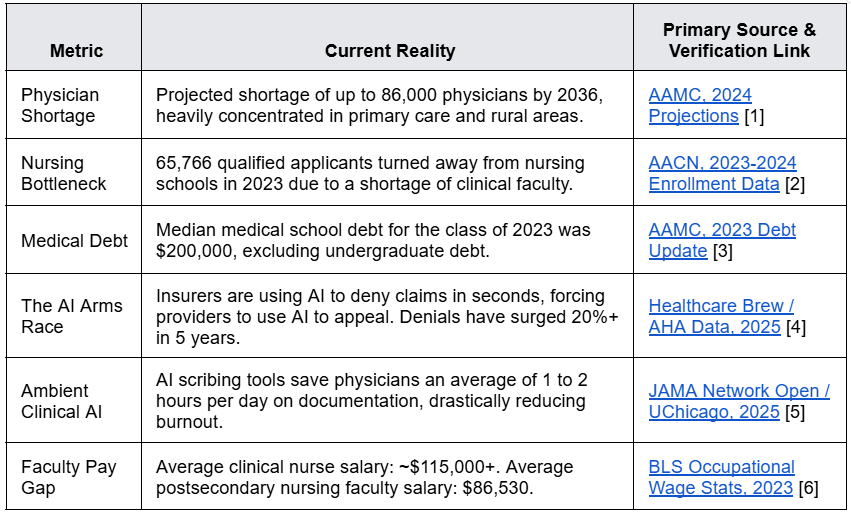
3. Baseline Facts: The Workforce Crisis
4. Deconstructing the Failure
The current workforce crisis is not an accident; it is the predictable result of systemic failures and misaligned incentives:
1. *The 1997 GME Freeze:* In the Balanced Budget Act of 1997, Congress capped the number of Medicare-funded Graduate Medical Education (GME) residency slots. We are artificially suppressing the supply of doctors to save pennies on training, while paying dollars on the back end for the resulting scarcity.
2. *Clinical Guild Protectionism:* Much of the U.S. medical education sequence (4 years undergrad + 4 years med school + 3 to 7 years residency) is heavily influenced by professional guilds acting as gatekeepers. This extended timeline is largely economic protectionism designed to restrict supply and protect compensation.
3. *The Nursing Faculty Bottleneck:* We do not have a shortage of people who want to be nurses; we have a shortage of people to teach them. The economic incentives are entirely inverted. If an experienced clinical nurse leaves the bedside to teach the next generation, that nurse takes a massive pay cut.
4. *Medical School Debt Distortion:* When a 28-year-old graduates with $300,000 in debt at 7% interest, they are no longer making clinical career choices. This debt load forces new doctors away from primary care and economically nudges them into more lucrative procedural sub-specialties.
5. *The AI Arms Race (The Robotic Tug-of-War):* Right now, the healthcare industry is treating AI as a financial weapon rather than a clinical tool. Insurers are deploying AI algorithms to more efficiently deny patient claims in milliseconds. In response, hospital systems are purchasing their own AI software to generate the appeals. This creates a “robotic tug-of-war”, machines fighting machines over billing codes. It consumes billions of dollars in software contracts and requires armies of administrative clerks to oversee, yet it treats exactly zero patients and produces zero health outcomes.
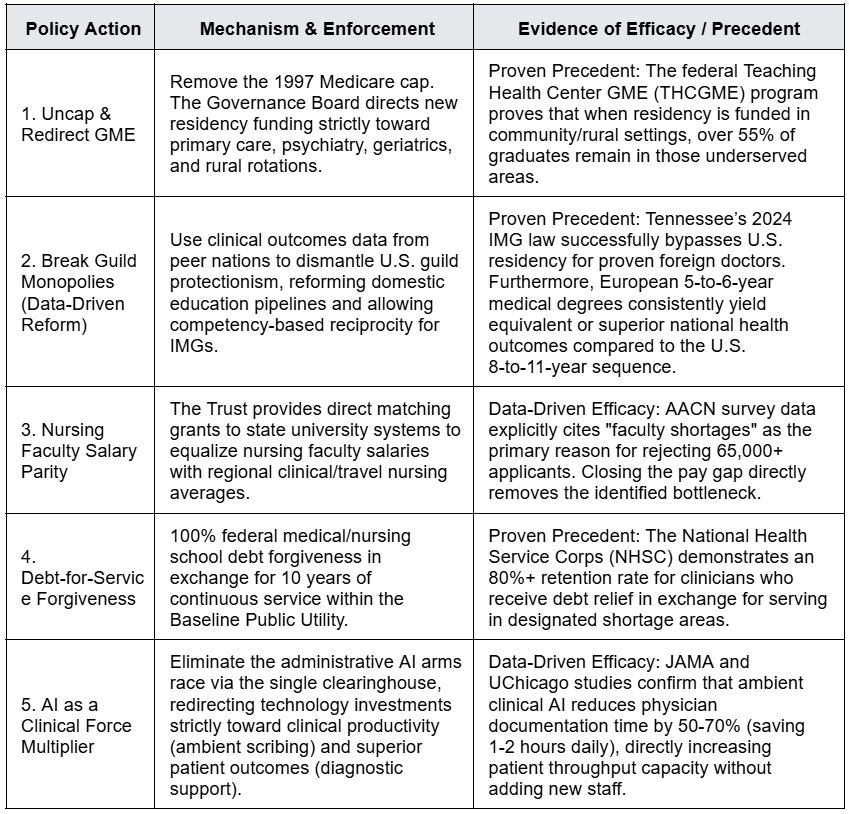
5. Actionable Solutions
Identifying the root causes of our workforce shortage is only the first step. To rebuild the human engine of American healthcare, we must deploy specific, enforceable policy levers that alter the economic and structural incentives driving clinician behavior.
The table below outlines the five core interventions required to uncap the supply pipeline, break protectionist monopolies, and maximize clinical productivity. Crucially, none of these are theoretical; each is backed by existing data, pilot programs, or international precedent demonstrating that if we change the rules, we change the outcomes.
6. Explanation of the Solutions
Fixing the Pipeline (Graduate Medical Education and Faculty):
We cannot fix the physician shortage overnight; it takes a decade to train a doctor. Therefore, we must immediately remove the 1997 cap on Graduate Medical Education (GME) slots. Rather than having a central board dictate exactly which specialties are funded—which risks unintended consequences and severe labor market skewing—we uncap the funding and let local community hospital needs and market demand drive the residency mix. Simultaneously, we address the nursing bottleneck by offering tax incentives for clinical preceptors and expanding capacity grants, allowing the market to naturally adjust faculty pay to meet the massive demand.
Competency vs. Pedigree (Using Global Data to Force Domestic Reform):
My assertion is that much of our required medical education is simple protectionism by clinical “guilds.” The strategic goal here is not to trigger a massive influx of foreign-trained clinicians, but to use the proven clinical models of peer industrialized nations (e.g., UK, Australia, Europe) to force reform of our own bloated system. If a 5-to-6-year direct-entry medical degree in Europe produces equivalent or superior patient outcomes compared to our 8-to-11-year sequence, we must accept the data. By establishing competency-based reciprocity for IMGs, we break the U.S. guild monopoly and open the door to revising our own domestic clinical education requirements.
Accelerated Pathways & Debt Reduction:
Historically, the U.S. has attempted to use “Debt-for-Service” contracts to force doctors into rural or primary care roles. Mandating where clinicians practice has largely failed, hurts the acceptance of the solution, and often drives up regional costs. Instead of forcing doctors into roles via debt contracts, we solve the debt problem at the root. By adopting the European 5-year direct-entry model or 3-year accelerated MD programs, we drastically reduce the $300,000 debt burden. When young doctors aren’t crushed by debt, the free market naturally distributes them across primary care and specialties based on actual demand, rather than debt-servicing needs.
AI as a Clinical Force Multiplier (Productivity & Outcomes):
By shifting to a single bundled-payment clearinghouse (the “Visa Model” discussed in HEA-003), we instantly kill the administrative robotic tug-of-war. There are no prior authorizations to deny, and no appeals to generate.
Once we eliminate this administrative waste, we can redirect technology toward its true purpose: clinical augmentation. The Governance Board will mandate and fund the integration of AI across the utility in two specific ways:
1. Increasing Productivity: Ambient clinical AI (which securely listens to the patient encounter and auto-generates the chart) removes the keyboard from the exam room. Data shows this saves physicians 1 to 2 hours a day. This effectively expands the capacity of our existing workforce by 15-20% overnight, without minting a single new doctor.
2. Superior Patient Outcomes: Integrating diagnostic AI (e.g., radiological pattern recognition, predictive analytics for sepsis) does not replace the physician, it provides a safety net. It reduces human error, catches anomalies earlier than the human eye, and directly drives superior clinical outcomes.
7. Baseline Utility vs. Private Commercial Market
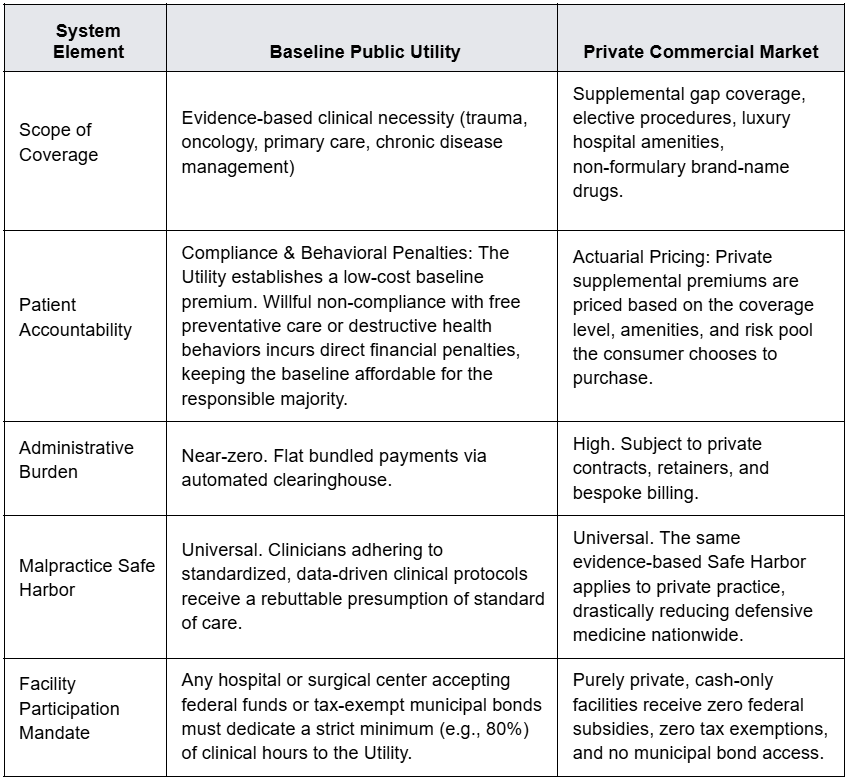
To ensure the system functions, we must establish clear, fiscally sound boundaries between the public system and the private commercial market. The architecture mirrors the highly successful division currently used by seniors: **Traditional Medicare plus Private Supplemental (Medigap) Plans.**
The National Health Utility provides the lower-cost, low-deductible baseline coverage for clinical necessity. The private market is preserved to sell supplemental insurance that covers elective upgrades, luxury amenities, or remaining out-of-pocket gaps.
The Necessity of the Penalty:
We must treat the American public like adults. The National Utility will provide a highly efficient, low-cost baseline of care, including zero-dollar preventative maintenance. However, if a patient willfully refuses to adhere to their preventative care, they will face direct financial penalties. We will not use the political gimmick of setting a high premium and offering “discounts.” The baseline cost of the Utility must remain low, and the financial consequence of irresponsible behavior must be borne by the individual, not subsidized by the responsible majority.
The Facility Participation Mandate:
We cannot allow taxpayer-subsidized hospitals to operate purely as luxury commercial facilities. If a hospital or surgical center utilizes tax-exempt municipal bonds or accepts federal infrastructure grants, they are legally bound to dedicate the vast majority of their clinical capacity to the Baseline Utility. If a provider wants to operate exclusively in the Private Commercial Sandbox, they must build and fund their facilities entirely with private, taxable capital. This ensures the best infrastructure and specialists remain accessible to the pragmatic majority.
8. The Three Big Wins for Voters
1. You Can Actually Get an Appointment: By uncapping GME, clearing the nursing bottleneck, and reforming our bloated training pipelines based on proven international models, we flood the zone with primary care providers.
2. Your Doctor Looks at You, Not a Screen: By deploying ambient clinical AI and forcing standardization through the clearinghouse, we remove the administrative burden that forces doctors to spend two hours on paperwork for every one hour of patient care.
3. Rural Healthcare is Resuscitated: By uncapping GME and reducing the upfront cost of medical education via accelerated pathways, we remove the financial barriers that prevent young doctors from opening practices in rural and underserved communities.
9. The Hard Trade-Offs
I must point out the vulnerabilities in this architecture.
AI Liability and Guild Resistance: The clinical guilds (AMA, specialty boards) will fight diagnostic AI just as fiercely as they fight IMGs. They will weaponize “patient safety” to protect their diagnostic monopolies. Furthermore, if an AI diagnostic tool misses a tumor, who is sued? The doctor? The software developer? The Board? We must establish a ruthless, universal legal standard: if a physician adheres to a Board-approved AI or clinical protocol, they are granted absolute malpractice safe harbor, whether they operate in the public utility or the private market. This universal tort reform is the only viable way to drastically reduce defensive medicine nationwide.
The “Job Killer” Attack: Political opponents will run attack ads featuring single mothers who lost their jobs as medical billers because the clearinghouse automated their roles. We must treat this as a massive industrial transition, akin to closing coal mines. The retraining grants must be robust, but we must stand firm: we cannot tax the American public to preserve unnecessary administrative jobs.
Specialist Income Normalization & The “Brain Drain” Threat: Procedural specialists will see their incomes normalize downward relative to primary care. The specialty lobbying groups will claim this will cause a “brain drain,” with top surgeons abandoning the public utility for the private, cash-only market. We must hold the line: the utility pays for value and outcomes, not historical prestige. Furthermore, the Facility Participation Mandate ensures that specialists cannot simply hide in taxpayer-subsidized hospitals while refusing utility patients. If they want the volume and the infrastructure, they must serve the baseline.
The Time Lag: The 20-year glide path is real. If we pass this tomorrow, it will still take 4 to 8 years to see the first wave of new domestic doctors and nurses hit the floors. We will have to manage expectations and rely heavily on AI force-multipliers and allied health professionals to bridge the gap in the interim.
10. The Path Forward
We cannot build a 21st-century healthcare utility on the backs of an exhausted, indebted, and artificially constrained workforce. By realigning the financial incentives of medical education, breaking the monopolies of clinical guilds using global outcomes data, and redirecting AI from an administrative weapon into a clinical force multiplier, we can rebuild the human engine of American healthcare.
But having the right people in place is only half the battle. Once we have the clinicians, we must ensure the physical infrastructure and supply chains can withstand systemic shocks.
Next in the Series: HEA-005: Operational Logistics, Emergency Hedging & Disaster Reserves. We will explore how to protect the utility from black-swan events, pandemics, and supply chain collapses without breaking the CPI expenditure cap.
11. Corroborating Evidence & Source References
Association of American Medical Colleges (AAMC): The Complexities of Physician Supply and Demand: Projections from 2021 to 2036 (March 2024). Details the projected shortfall of up to 86,000 physicians, heavily concentrated in primary care.
American Association of Colleges of Nursing (AACN): 2023-2024 Enrollment and Graduations in Baccalaureate and Graduate Programs in Nursing. Documents the 65,766 qualified applicants turned away due to faculty and clinical site shortages.
Association of American Medical Colleges (AAMC): Physician Education Debt and the Cost to Attend Medical School: 2023 Update. Confirms median debt levels driving specialty selection.
American Hospital Association (AHA) / CAQH Index: Data tracking the surge in AI-driven claim denials by commercial insurers and the corresponding billions spent by providers on administrative appeals (The “Robotic Tug-of-War”).
JAMA Network Open / University of Chicago: Studies on Ambient Clinical Documentation. Confirms that AI scribing tools reduce physician documentation time by 50-70%, saving an average of 1 to 2 hours per clinical shift.
Bureau of Labor Statistics (BLS): Occupational Employment and Wage Statistics (2023). Highlights the wage disparity between clinical nursing roles and postsecondary nursing instructors.
Health Resources & Services Administration (HRSA): Data on the Teaching Health Center Graduate Medical Education (THCGME) program and the National Health Service Corps (NHSC), proving high retention rates for clinicians trained in community settings and those receiving debt-for-service relief.
Tennessee Public Chapter No. 513 (2024): State legislation establishing a pathway for International Medical Graduates (IMGs) to bypass U.S. residency requirements and obtain provisional licensure based on demonstrated competency
.