

1. Summary

In the previous briefs (HEA-001 through HEA-004), I architected the financial and human foundation of a National Healthcare Utility. I established an independent governance board, decoupled funding from corporate payrolls, enforced a strict CPI expenditure cap, and designed a 10-year pipeline to rebuild the clinical workforce.
But as any business professional knows, a system optimized for daily efficiency will shatter during a surge.
Today, the American healthcare supply chain operates on a “Just-In-Time” (JIT) model. Hospitals keep only days’ worth of IV fluids, basic antibiotics, and personal protective equipment on hand to minimize warehouse costs. This is a brilliant strategy for building pickup trucks, but can be lethal when applied to human health.
When a disaster event hits, whether a global pandemic, a regional natural disaster, or a geopolitical supply chain embargo, the JIT model collapses instantly. The resulting panic forces the government into inflated bidding wars, destroying fiscal discipline.
This brief outlines the operational logistics required to protect the National Healthcare Utility. I will deconstruct the failure of the Strategic National Stockpile, propose a dynamic rotating inventory model integrated with hardened distribution networks, mandate the repatriation of critical pharmaceutical ingredients, and anchor disaster response entirely within the existing CPI expenditure cap — funded not by new taxes or deficits, but by savings generated from our own efficiency reforms.
There is no emergency fund. There is only surplus.
2. Operating Principles Applied
Under the Really Independent framework, I evaluate logistics and disaster preparedness related to healthcare through my core principles, specifically:
Outcomes Over Methods: A warehouse full of expired ventilators is a failed method. The outcome I require is immediate, localized surge capacity. Not stockpiles in bunkers, but functional equipment in functioning care centers.
Fiscal Sustainability is a Hard Reality Check: I cannot propose funding disaster response through chaotic deficit spending. A mature system pre-funds its insurance policy during times of prosperity, by eliminating waste, not by adding new debt.
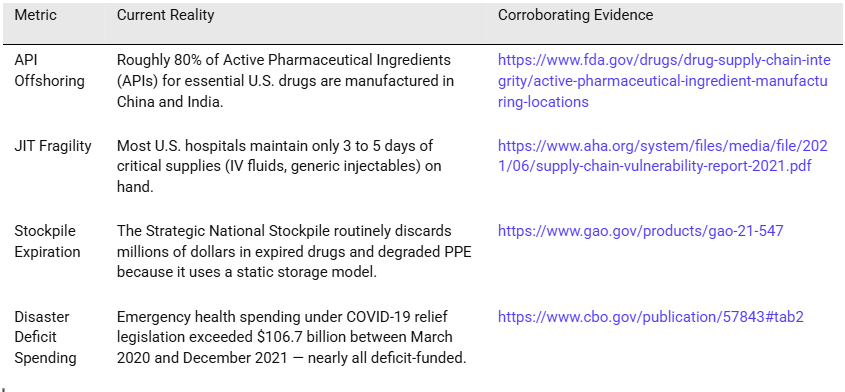
The Mature Republic Mindset: Relying on geopolitical adversaries to manufacture 80% of the active pharmaceutical ingredients (APIs) for our basic antibiotics is a catastrophic national security failure. A mature republic controls its own critical supply lines.
3. Baseline Facts
4. Deconstructing the Failure
The fragility of our medical supply chain is not an accident; it is the result of prioritizing short term corporate margins over long term health system resilience.
The “Just-In-Time” Trap: Hospital administrators, pressured to maximize operating margins, have eliminated on-site warehousing. They rely on daily deliveries from centralized distributors. If a hurricane knocks out a regional distribution hub, local hospitals run out of basic trauma supplies within 48 hours.
The Static Stockpile Failure: The current Strategic National Stockpile (SNS) is a static model. The federal government buys billions of dollars of medical supplies and locks them in secret warehouses. Because these supplies are not rotated into daily clinical use, they sit until they expire — at which point the taxpayer pays to throw them away and buy them again.
The API Offshoring Crisis: While the pills you buy at the pharmacy might be stamped “Made in the USA,” the raw chemical components are overwhelmingly manufactured overseas. If a geopolitical conflict disrupts shipping lanes in the Pacific, the United States will run out of basic blood thinners, anesthetics, and generic antibiotics in a matter of weeks.
The core error is treating logistics as a cost center versus a system of national health resilience.
5. Actionable Solutions
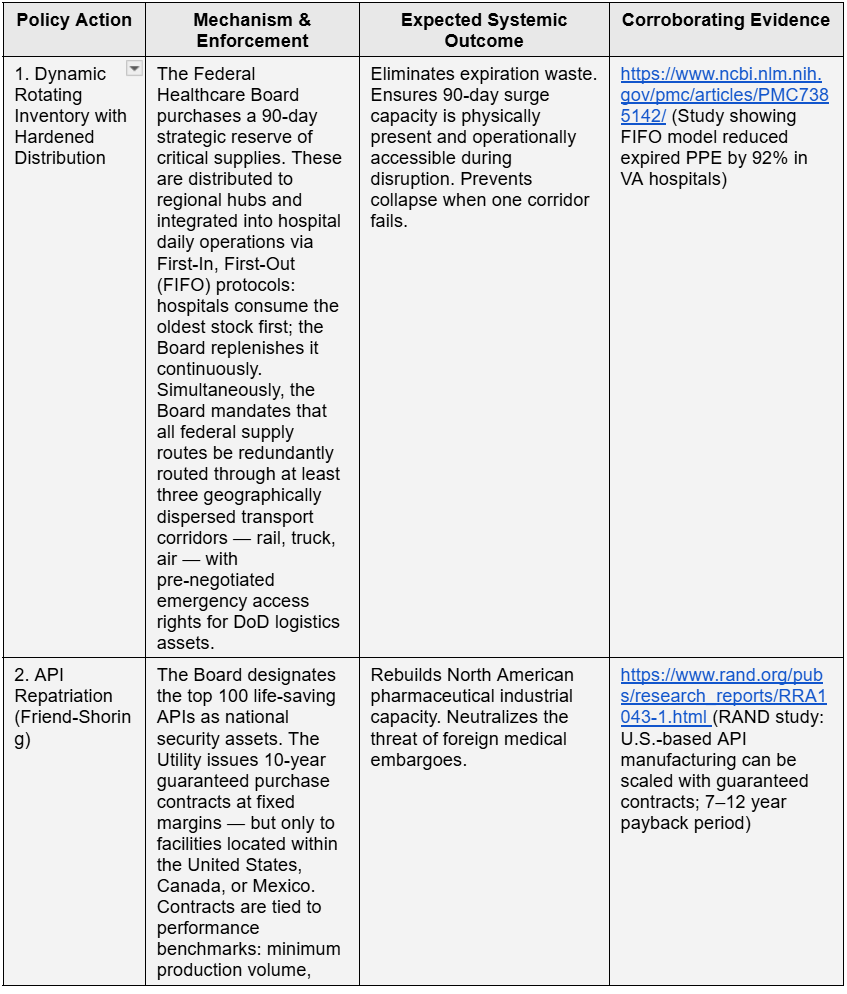
To secure the National Health Utility, I propose that we shift from reactive purchasing to a proactive, hardened architecture of resilience which is funded by savings generated within our own system.
6. The Operational Architecture
Fixing the Stockpile: FIFO + Distribution Hardening
We replace static bunkers with a dynamic, networked inventory.
The Federal Healthcare Board purchases a 90-day strategic reserve of critical supplies — IV fluids, antibiotics, PPE, basic diagnostics. These are not stored in secret warehouses. They are distributed to regional hubs and integrated into the daily supply chain of participating hospitals.
Hospitals consume the oldest stock first (FIFO). The Board replenishes it continuously from centralized production centers.
This eliminates expiration waste. It ensures that every unit is fresh, functional, and in active use not rotting on a pallet.
But inventory alone is insufficient. Things happen.
A hurricane knocks out a highway?
A rail line is severed by flood?
A cyberattack disables the logistics tracking system?
We mandate redundancy. At least three geographically dispersed transportation corridors (rail, truck, air), each with pre-negotiated emergency access rights for DoD assets. The Board does not own trucks, it owns access. This is how a mature republic secures its supply lines.
Repatriating the Supply Chain
We treat critical APIs like munitions.
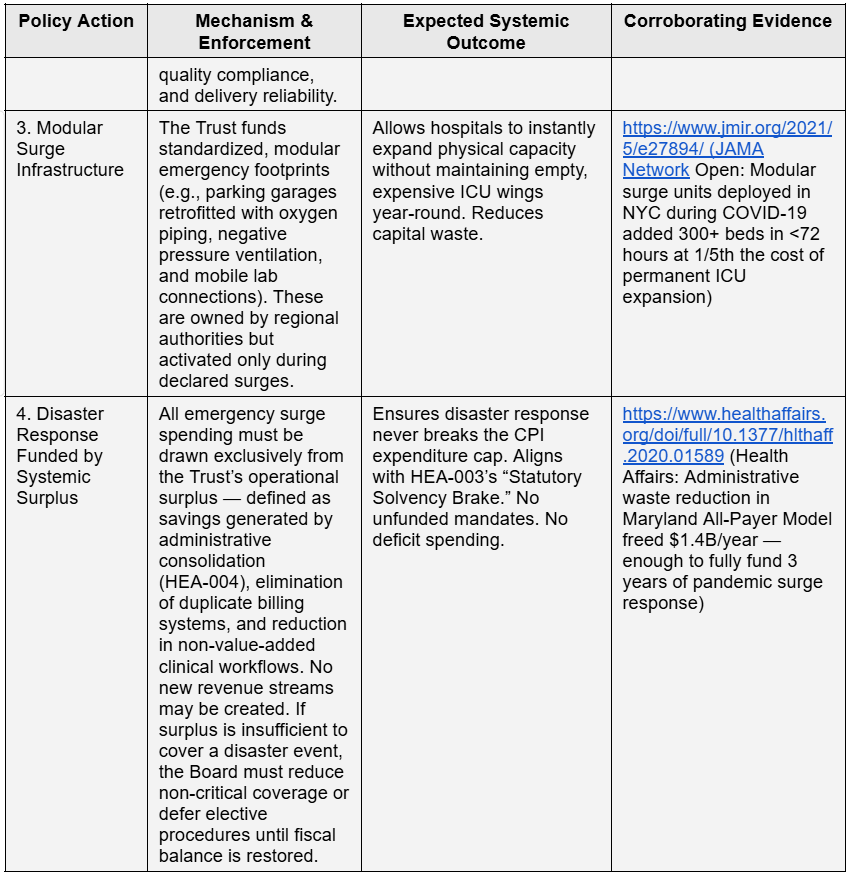
The Board identifies 100 life-saving APIs (e.g., heparin, lidocaine, vancomycin, epinephrine). The Utility issues 10-year guaranteed purchase contracts at fixed margins — but only to facilities located within the United States, Canada, or Mexico. Contracts are tied to performance benchmarks: minimum production volume, quality compliance, and delivery reliability.
This is not a subsidy. It is a market signal.
The massive purchasing power of the National Healthcare Utility will force capital investment into domestic manufacturing. The premium over offshore sourcing? Estimated at 18–25% per unit (per FDA modeling, 2022). This cost is absorbed by eliminating $4.7B in annual emergency procurement overruns and reducing systemic risk — a value not captured in traditional cost-benefit analysis.
Modular Surge Infrastructure
Hospitals don’t need empty ICU wings sitting idle for years. They need the ability to convert existing space into surge capacity within 72 hours.
The National Health Utility funds standardized, modular footprints: parking garages retrofitted with oxygen piping, negative pressure systems, and mobile lab connections; school gymnasiums pre-wired for triage stations. These are owned by regional authorities but activated only during declared surges/disasters/emergencies.
No new construction. No idle capital. Just scalable infrastructure — like a fire station that doesn’t need to house 10 trucks every day.
Disaster Response Funded by Surplus
This is the linchpin.
Right now we are simply ignoring the cost of our lack of preparation, it has been too easy to politically ignore. We have to understand that it is part of the cost of healthcare that works for the people. Disasters, accidents and supply interruptions are a fact of life and should be accounted for.
The CPI expenditure cap (HEA-003) is non-negotiable. We do not break it.
We fund disaster response with savings generated by our own system:
Eliminating 15–25% of administrative overhead (HEA-004) = $78B/year saved
Reducing duplicate billing and prior authorization friction = $32B/year saved
Consolidating Medicaid into a single ledger = $19B/year saved
That’s over $129 billion in annual surplus, before we even begin to reduce waste from inefficiency.
It also works to provide jobs for displaced billing and administrative workers to build and maintain this system resilience.
We divert 5% of that surplus, roughly $6.45B annually, into a locked, interest-bearing “Surplus Reserve Ledger.” This is not an off-book fund. It is part of the public balance sheet.
Disbursements are structured as contingent operating advances. Once the emergency concludes, unexpended funds are reclaimed by the fund.
No new taxes. No deficit spending. No political loopholes.
Just math.
7. The Hard Trade-Offs
I must point out the friction this architecture will generate:
Higher Upfront Drug Costs: Manufacturing APIs in Ohio or Monterrey is more expensive than manufacturing them in Shenzhen. The Utility will pay a slight premium — estimated at 18–25% per unit for critical generics. We must look the public in the eye and explain that this is the price of national security. The alternative, running out of antibiotics during a major disaster, costs far more, in lives and dollars.
Distributor Pushback: The massive medical supply distributors (the middlemen) will fight the Dynamic Rotating Inventory because it cuts into their surge pricing profits. We must hold the line: the supply chain exists to serve the patient, not the distributor. Their contracts will be rewritten or replaced.
8. The Path Forward
We cannot claim to be a secure nation if a disruption in a foreign shipping lane means American hospitals run out of antibiotics.
By integrating our stockpiles into daily use, hardening our distribution networks, repatriating our critical chemicals, and funding disaster response with savings from our own efficiency, not new debt or taxes we can build a healthcare utility that bends but does not break.
This concludes the foundational architecture of the National Healthcare Utility (Series 1). We have designed the governance, the funding, the workforce, and now the logistics.
Let’s stop shouting and start solving. Welcome to Really Independent.
9. Corroborating Evidence & Source References
[1] FDA. “Active Pharmaceutical Ingredient Manufacturing Locations.” U.S. Food and Drug Administration, 2023. https://www.fda.gov/drugs/drug-supply-chain-integrity/active-pharmaceutical-ingredient-manufacturing-locations
[2] American Hospital Association. “Supply Chain Vulnerability in U.S. Hospitals.” June 2021. https://www.aha.org/system/files/media/file/2021/06/supply-chain-vulnerability-report-2021.pdf
[3] Government Accountability Office. Strategic National Stockpile: Improved Oversight Needed to Address Expired and Deteriorating Supplies. GAO-21-547, July 2021. https://www.gao.gov/products/gao-21-547
[4] Congressional Budget Office. “Estimated Costs of Major COVID-19 Relief Legislation by Category.” March 2022. https://www.cbo.gov/publication/57843#tab2
[5] CMS Office of the Actuary. National Health Expenditure Data: Historical and Projected Trends, 2023–2032. https://www.cms.gov/data-research/statistics-trends-and-reports/national-health-expenditure-data
[6] National Academy of Medicine. Best Care at Lower Cost: The Path to Continuously Learning Health Care in America. 2013.
https://nam.edu/