


In my foundational post for this series (Healthcare in the USA / HEA-000), I established that American healthcare is an eighty-year-old, five-trillion-dollar machine carrying massive technical debt. It accounts for nearly 20% of the nation’s entire economy, yet our political leaders treat it as an ideological campaign wedge rather than an enterprise risk challenge.
In that post, I pointed out five specific structural failures. Today, we begin our deep dives by taking on Failure #1: The Broken Cost-to-Value Gap.
Think about it like this...
Imagine you bought a heavy-duty pickup truck that cost twice as much as any other truck on the market. It burns twice as much fuel, breaks down twice as often, and the engine permanently seizes up at 100,000 miles. Your neighbor’s truck costs half as much and easily runs for 250,000 miles.
You wouldn’t defend the dealership. You wouldn’t call it “the greatest vehicle in the world.” You would be more likely to demand an investigation into it as a defective product.
Yet, that is the exact contract the American public accepts for healthcare every day. We spend more money than any nation on healthcare. We receive shorter lives, higher maternal mortality rates, and worse chronic disease outcomes in return.
Before we look at household medical debt or hospital balance sheets, we must examine the economic engine of healthcare. Why do healthcare costs escalate relentlessly? Where does that money actually go? How do we put a freeze on the cost curve?
Operating Principles Applied
As established in my publication charter (About Really Independent / INT-000), I evaluate this crisis against strict principles:
Fiscal Sustainability is a Hard Reality Check: Math does not care about political promises. When healthcare costs consistently grow at 5% to 7% annually while the general economy and wages grow at 2% to 3%, the system is on an unsustainable path to insolvency. Policies that bankrupt families and pile trillions onto the national debt to subsidize the current cost make no sense.
Outcomes Over Methods: A system cannot be defended based on its noble intentions, corporate pedigree, or political rhetoric. If an economic model consumes nearly one-fifth of our gross domestic product and delivers worse overall results than peer nations, the model has failed and must be restructured.
Baseline Facts on Cost vs. Value
Before proposing solutions, we must establish the truth using primary source, non-partisan data that stands up to cross-examination in a court of US law.
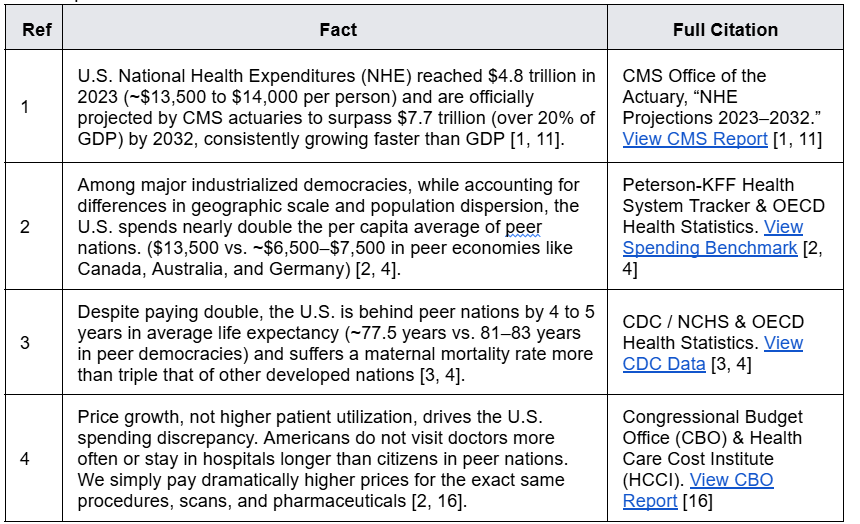
Deconstructing the Problem — My Opinion
To fix this failure, we have to look at the economics driving healthcare inflation.
Most Americans assume healthcare is expensive because we are an aging population or because we use too much medical care.
That is not true.
Multiple studies from the Health Care Cost Institute and the Congressional Budget Office confirm that Americans visit doctors and check into hospitals at rates roughly equal to, or lower than, our international peers [16].
The problem is not that we consume too much care. The problem is the price.
In every other sector of the American economy, technological advancement and market maturity drives costs and prices down.
A flat-screen television that cost $3,000 twenty years ago costs $300 today, with a superior picture. Telecommunications, computing, logistics, and manufacturing all pass efficiency gains on to the consumer.
Healthcare is the only major industry where technology and scale are consistently weaponized to drive prices up.
Three specific operational design flaws drive this broken engine:
1. The Compounding Math of Runaway Inflation
When healthcare costs grow at 5% to 7% every year, on a multi-trillion-dollar base, healthcare spending doubles roughly every 12 to 14 years.
That money does not materialize from thin air. It is extracted directly from the rest of the economy:
From Worker Paychecks: Employers budget a single total compensation figure for every employee. When corporate health insurance premiums jump 7% year after year, your employer does not cut into executive bonuses or company profits; they quietly eliminate your pay raise. For thirty years, real wage growth in America has been swallowed whole by health insurance inflation.
From Municipal and State Budgets: Healthcare is eating our local government budgets. School districts are forced to freeze teacher salaries and cut educational programs because health benefits for staff are rising faster than property tax revenues. City councils delay road paving and bridge repairs because municipal employee health plans consume their operating reserves.
2. The Unregulated Pricing Machine & Opaque Monopolies
In a normal market, when two competitors merge, scale creates efficiencies that lower prices for consumers. In American healthcare, the exact opposite occurs.
Over the last two decades, private equity firms and large hospital networks have purchased independent physician practices, regional clinics, and rural facilities. When a hospital system buys the only three cardiology clinics in a regional market, they don’t lower prices. They use the new regional “monopoly power” to dictate terms.
“Facility fees” are added to routine office visits, charging $800 for an injection that cost $150 the week before, and demand secret, non-negotiable contract clauses with commercial insurers. If an insurer refuses to pay their inflated prices, the hospital threatens to drop out of the network, leaving thousands of local families without doctors.
3. The Cross-Subsidization Game
As a former hospital CFO, I have seen this dynamic firsthand on the general ledger.
Government programs, Medicare and Medicaid, underpay the actual fully loaded cost of delivering hospital care, reimbursing roughly 83 cents on every dollar of hospital expense [14]. Hospitals do not simply absorb that loss; they subsidize the Medicare/Medicaid deficit by charging more to commercial employer plans, often by as much as 200% to 250%.
Commercial insurers are now actively fighting back against that markup. The result is that insurers arbitrarily deny claims and drop hospital networks, while hospitals counter by hiring more billing specialists and increasing chargemaster prices, and the consumer gets caught in the middle with an $8,000 deductible which they never saw coming.
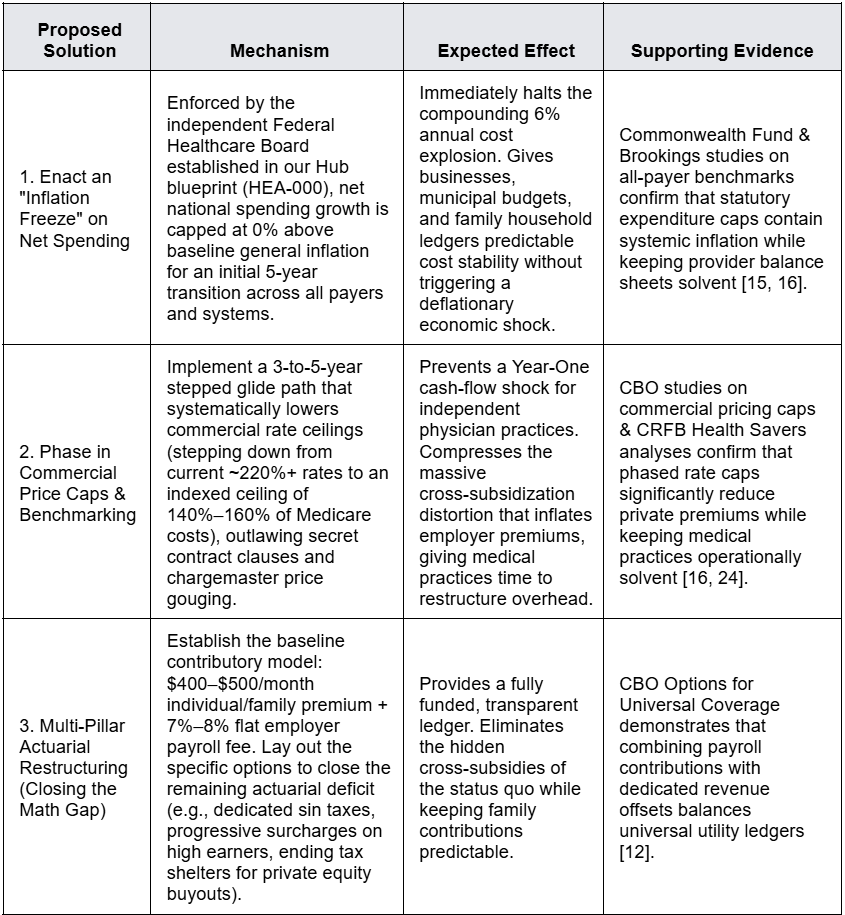
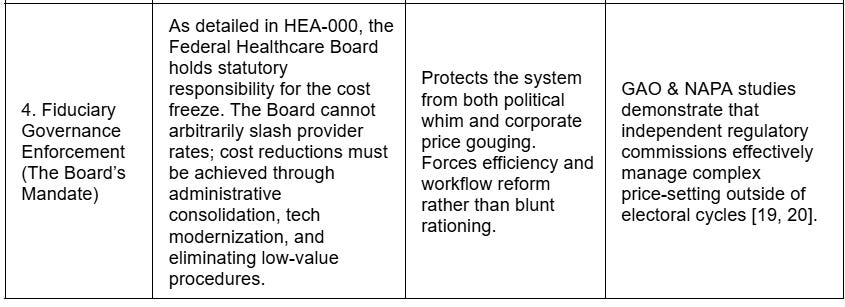
Actionable Solutions
Fixing the cost-to-value gap does not require an ideological revolution. It requires implementing hard, enterprise cost containment mechanisms that stabilize the balance sheet:
The Hard Trade-Offs
In accordance with one of my core principles:
Solutions Are Never Perfect (Expect Compromise and Trade-Offs)
We must confront the friction this solution will generate:
1. Managing the Physician & Hospital Margin Squeeze
Opponents of price caps will immediately claim that limiting commercial rates will bankrupt doctors and close clinics. If we implemented an overnight 40% cut, they would be correct.
Independent medical practices and community clinics operate with high fixed costs, budgeted clinical staff salaries, malpractice coverage, and facility overhead. A sudden revenue shock in Year One would put thousands of physician practices in jeopardy.
That is why reform must propose a 3-to-5-year stepped glide path. By lowering rate ceilings incrementally, capping the most egregious 300% chargemaster markups in Year One, then stepping down to 180%, 160%, and settling at 140%–150% over several years, we give practice managers and hospital CFOs the operational runway needed to adapt.
More importantly, because this reform simultaneously slashes administrative paperwork and billing friction (as we will examine in HEA-004), practices will spend vastly less money on non-clinical billing staff and claims appeals, directly offsetting the reduction in commercial markups.
2. The “Rationing” Scare Tactic
Status-quo defenders and corporate lobbyists will immediately claim that freezing expenditure growth means “cutting care.” That is a dishonest scare tactic.
Freezing price growth is not cutting care. I propose capping the inflation of the price tag, not the volume of medicine delivered. When the government regulates the price per kilowatt-hour of electricity, the power company doesn’t turn off the lights in your living room. It simply operates under a regulated public utility rate. Healthcare must be governed by that exact same thinking.
3. Confronting the Funding Gap Honestly
As a nation, we must deal with reality:
A $500 monthly family premium combined with an 8% employer payroll fee will not cover 100% of our current $4.8 trillion national healthcare bill. Anyone who claims otherwise is lying about the numbers involved.
To close that remaining gap without running up national debt, we must deliberate on funding options:
Do we establish dedicated, locked excise taxes on ultra processed foods and tobacco?
Do we apply a modest surtax on non-wage capital gains for high earners?
Do we eliminate the tax-deductibility of pharmaceutical advertising and private equity debt loading?
There are multiple viable paths to close that gap in funding. But the first prerequisite is capping the spending growth. If your household budget is bleeding money, you don’t argue about where to borrow more cash until you first stop the spending leaks.
The Path Forward
We cannot fix American healthcare until we stop treating its five-trillion-dollar price tag as routine. The cost-to-value gap is not an accident; it is the predictable result of an unregulated pricing cartel funded by corporate subsidies.
By freezing cost growth at zero percent above inflation, capping commercial price markups, and establishing an independent board to manage the balance sheet, we can finally stop the bleeding and stabilize the American economy.
A republic is not a spectator sport, and neither is this publication. I do not expect you to agree with every mechanism proposed above.
Instead, treat this like a professional working group:
If an independent board froze healthcare price increases at general inflation starting next year, how would that change your business or family financial planning?
Which funding mechanism to close the remaining actuarial gap makes the most economic sense to you?
Add your professional and life experience to the discussion. Comments are moderated strictly for substance and mutual respect. Leave the bumper stickers and partisan talking points at the door.
Next week, we move from the national balance sheet down to your kitchen table. In HEA-002: Medical Debt and Family Budget Devastation, we will audit why health insurance currently leaves 41% of Americans in debt, why holding an insurance card fails to protect your family from collections agencies, and how we re-engineer coverage into an ironclad financial shield that renders medical bankruptcy legally obsolete.
Let’s stop shouting and start solving. Welcome to Really Independent.
Corroborating Evidence & Source References
[1] CMS Office of the Actuary: National Health Expenditure Projections & Data [1]
[2] Peterson-KFF Health System Tracker: How Does Health Spending in the U.S. Compare to Other Countries? [2]
[3] CDC National Center for Health Statistics (NCHS): Life Expectancy and Maternal Mortality Data [3]
[4] OECD Health Statistics: Health at a Glance Comparative Database [4]
[11] CMS Office of the Actuary: NHE Projections 2023–2032 [11]
[12] Congressional Budget Office (CBO): Options for Universal Health Care Coverage [12]
[14] Medicare Payment Advisory Commission (MedPAC): Report to the Congress: Medicare Payment Policy [14]
[15] The Commonwealth Fund: International Health System Profiles: Australia, France, Germany [15]
[16] Congressional Budget Office (CBO): Policies to Reduce the Prices That Commercial Insurers Pay for Hospitals and Physicians [16]
[19] Government Accountability Office (GAO): Military Base Realignments and Closures: Key Lessons [19]
[20] National Academy of Public Administration (NAPA): Independent Boards and Regulatory Governance [20]
[24] Committee for a Responsible Federal Budget (CRFB): Health Savers Initiative: Policy Options to Lower Health Care Costs [24]