


Executive Summary
The Core Failure: The United States does not have a broken healthcare system; we have an a fragmented non-system. Total spending reaches $5.3 trillion annually—more than our entire federal government spends on Social Security and National Defense combined. Yet this massive apparatus is governed without an architect, held hostage by 24-month election cycles and commercial cartels that profit from administrative friction.
The Root Causes: Annual political budget hostage-taking; state treasuries trapped by compounding Medicaid mandates; institutional IT platforms that intentionally refuse to share data; and predatory “facility fees” that mark up outpatient care based solely on the logo on the clinic door.
The True Cost Reality: Americans are already paying for universal care through five fragmented, predatory straws—totaling over $25,000 to $30,000 annually per family. Consolidating this into a transparent baseline utility provides an immediate middle-class discount.
The Solution (The Governance Firewall):
An Independent Governance Board: A protected utility commission (staggered 12-year terms) to manage the national trust, enforce data interoperability, and set site-neutral payment rules.
The CPI Cap & Day-One Solvency Rule: Spending growth is pinned to general inflation (CPI). Benefit expansions are legally barred unless funded on Day One with realized savings or dedicated revenues—no deficit financing, no debt, and no unfunded mandates.
Pure Employment Decoupling: Sever healthcare from corporate payrolls. Fund the baseline utility via an earmarked progressive individual tax and a flat statutory percentage on net corporate profits—ending the tax on hiring human labor while capturing the automation dividend of capital.
State Accountability & The 5% Fiscal Collar: Transition states to contributing based on audited prior-year usage, protected by an annual 5% growth cap during downturns, rewarding prevention while ending state Medicaid bureaucracies.
Dismantling Everyday Fraud: Replace fee-for-service a la carte billing with flat bundled procedure rates, algorithmic pre-payment screening, a strict ban on physician self-referrals, and a double-blind audit firewall led by a 15-year independent Comptroller.
Site-Neutral Bundling & Safe Harbor: Pay for clinical procedures, not hospital real estate, while granting physicians legal safe harbor from malpractice lawsuits when adhering to evidence-based protocols.
The Three Voter Wins: Lifetime universal portability (you never lose your care); out-of-pocket costs capped at $2,000 to 2,500/year(0 for primary care, checkups, and certified vaccines); and a middle-class jobs engine redirecting billing waste into front-line nursing and allied health careers over a 20-year glide path.
A few months ago, I needed to update several routine vaccinations: shingles, tetanus, Covid-19, and the annual flu shot.
My primary care physician’s office informed me that due to convoluted insurance contract rules, receiving those routine vaccines in the exam room would trigger hundreds of dollars in out-of-pocket charges. Yet, if I drove across the street to the grocery store pharmacy, the exact same vaccines would be administered for zero dollars.
Same medicine. Same clinical outcome. Completely different financial rules based entirely on behind-the-scenes billing games.
It got worse.
After receiving the shots at the retail pharmacy, their multi-billion-dollar IT infrastructure was entirely unable to transmit the documentation into my physician’s electronic health record. The software platforms simply refused to communicate. To get my medical chart updated, I had to ask the pharmacist for paper printouts, get in my car, and drive them over to my doctor’s clinic myself.
In a nation that instantaneously processes global financial transactions and routes satellites in low-Earth orbit, an American patient was forced to act as a manual paper courier between two corporate healthcare giants.
That absurdity illustrates the fundamental reality of this debate: The United States does not have a healthcare system. We have a Fragmented Non-System.
It was never engineered by anyone. It is an accidental collision of competing profit centers, legacy regulations, and institutional silos that actively profit off friction.
Before we can permanently fix medical debt or freeze the cost curve, someone must actually be put in charge of the enterprise architecture. Today, I move from the kitchen table to the engine room: how we establish an independent, accountable governing structure that forces healthcare to integrate, protects it from political budget tampering, and delivers an undeniable win for the American middle class.
Operating Principles Applied
As established in my publication charter (About Really Independent / INT-000), I evaluate this governance challenge against strict operational principles:
The “Mature Republic” Mindset: A mature nation builds durable, integrated infrastructure designed to last generations rather than lurching from one short-term political crisis to the next. Managing an enterprise larger than the combined budgets of Social Security and national defense requires long-term enterprise planning, not two-year election cycles.
Fiscal Sustainability is a Hard Reality Check: No governing structure can survive if the math fails. We cannot provide what we cannot fund. A legitimate public utility must balance its ledger using hard revenue and realized efficiencies, permanently banning the practice of borrowing from the future to subsidize the present.
Outcomes Over Methods: The measure of governance is not the pedigree of the bureaucracy or the nobility of its mission. It is whether the governing body delivers functional outcomes: lower costs, universal portability, seamless clinical workflows, and absolute protection against financial ruin.
Baseline Facts
Before proposing solutions, I must establish the baseline failure using primary-source, non-partisan data that reflects the fiscal and operational reality of the current model.
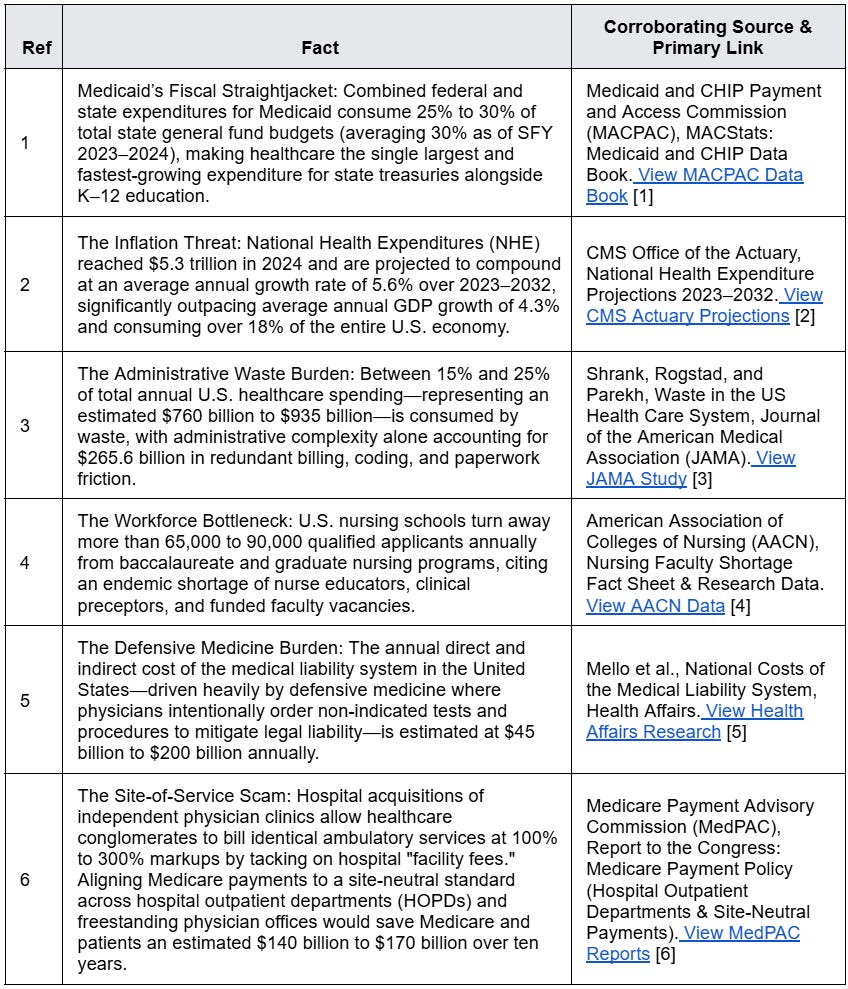
Deconstructing the Governance Failure
Why has every attempt at healthcare reform over the last eighty years failed to stabilize costs or protect families?
Because we continue to make the fatal mistake of treating healthcare governance as an ideological legislative football rather than an essential public utility.
The operational breakdown stems from five structural failures:
1. The Two-Year Political Budget Cycle & The Hidden Empire
To understand why healthcare reform always fails, you must first comprehend the sheer scale of the machine we are dealing with.
In 2024, total U.S. National Health Expenditures reached $5.3 trillion [2].
That number is so vast it loses meaning, so let’s ground it in reality:
It is more than double our entire federal government’s spending on Social Security and National Defense combined. Every aircraft carrier, fighter jet, Marine battalion, and Pentagon contract—added to every single retirement check sent to 70 million American seniors—totals roughly $2.3 trillion. Healthcare costs more than twice that amount every single year.
It is larger than the entire economy of Germany, Japan, or the United Kingdom. If the U.S. healthcare system were an independent nation, its economy would be the third largest on Earth, trailing only the United States and China.
It breaks down to over $15,400 for every man, woman, and child in America. A family of four represents over $61,000 in annual healthcare consumption—more than what that same family spends on food, housing, gasoline, and utilities combined.
Managing an enterprise of that magnitude requires decades-long strategic planning. Leaving it to members of Congress facing 24-month election cycles guarantees that healthcare funding is routinely threatened by debt-ceiling standoffs, government shutdown threats, and midnight omnibus reconciliation bills.
2. The State Treasury Trap
By splitting public healthcare across fifty separate state Medicaid programs, we have turned state governments into financial hostages. Medicaid functions as a coercive federal mandate that consumes nearly a third of all state tax dollars [1].
Every dollar spent subsidizing runaway healthcare inflation is a dollar stripped directly from state highway repairs, bridge maintenance, police funding, and public school classrooms. States cannot print currency; when healthcare costs spike, local services are slashed.
3. The Architecture of Intentional Friction
Because no single entity has the statutory authority to enforce enterprise standards, market participants optimize for their own balance sheets at the expense of the patient. Hospitals purchase electronic health record systems designed to lock in market share rather than share clinical data. Commercial insurers construct complex claims-denial algorithms to delay and avoid reimbursement.
The result is an administrative arms race costing $265.6 billion in pure paperwork waste [3], where providers hire armies of billing clerks simply to fight the armies of claims adjusters hired by payers—all funded by the consumer’s premium dollars.
4. Site-of-Service Arbitrage and Facility Fees
The current system does not pay for clinical outcomes; it pays for physical real estate. Over the last decade, hospital conglomerates have acquired thousands of independent physician practices and ambulatory surgery centers [6].
By rebranding these clinics as “Hospital Outpatient Departments,” they bill Medicare and private insurers massive “facility fees”—often adding $1,500 to $4,000 to an invoice for the exact same injection, scope, or minor surgery that cost a fraction of that amount the week prior [6]. It is an accounting shell game that inflates national costs without adding an ounce of clinical value.
5. The Illusion of “What You Pay”: The Five Hidden Straws
Opponents will inevitably attack reform by claiming that establishing a baseline national utility requires an unaffordable “new tax.” That is an accounting illusion. The American public is already paying the full cost of universal healthcare—we are just paying for it through five fragmented, predatory straws:
The Visible Paycheck Toll: The employee premium deducted from your paycheck ($4,000 to $7,000 annually for a family plan).
The Invisible Wage Theft (The Employer Share): The average employer contributes over $17,000 per year for family coverage [9]. That is not a corporate gift; it is your compensation. It is cash that would otherwise be in your take-home pay, quietly siphoned off before you ever see your paycheck.
The Point-of-Care Tax: The deductibles, copays, coinsurance, and surprise “out-of-network” bills that force families to drain personal savings ($2,000 to $10,000+ per medical event).
The General Tax Subsidies: Your existing federal and state taxes that already fund Medicare, Medicaid, and local public subsidies (devouring nearly 30% of state general funds) [1].
The Bad-Debt Surcharge & Civic Bailouts: When hospitals absorb uncompensated emergency care, they don’t eat the loss; they mark up routine supplies and minor procedures by 1,000% on commercially insured patients to balance the books. When that fails, citizens are forced onto GoFundMe or rely on private charity to bridge what should be basic infrastructure.
Add up all five straws, and the average American family is already paying over $25,000 to $30,000 every single year for an adversarial non-system that threatens them with bankruptcy the moment a major illness strikes.
Consolidating this chaotic mess into a transparent utility isn’t an added cost; it is a massive, multi-thousand-dollar net discount for the American middle class.
Solutions
Fixing American healthcare does not require a chaotic government takeover of medical delivery, nor does it mean surrendering to corporate cartels.
I propose building an independent Healthcare Governance Firewall that isolates the management of healthcare from political interference and enforces process control.
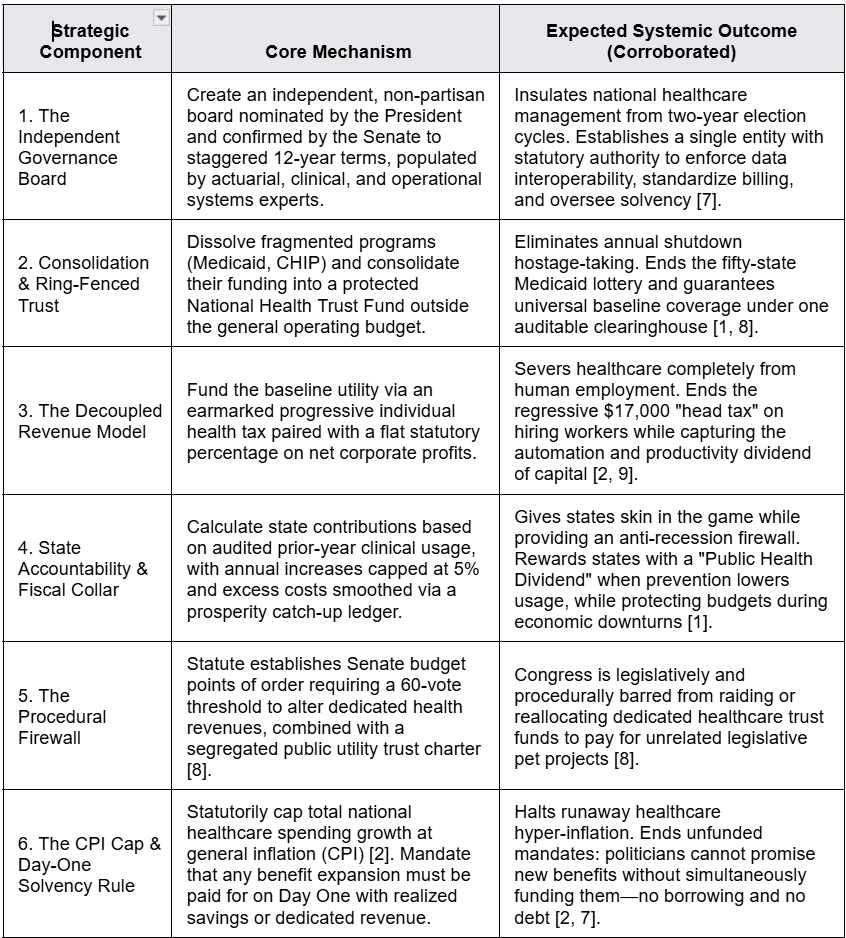
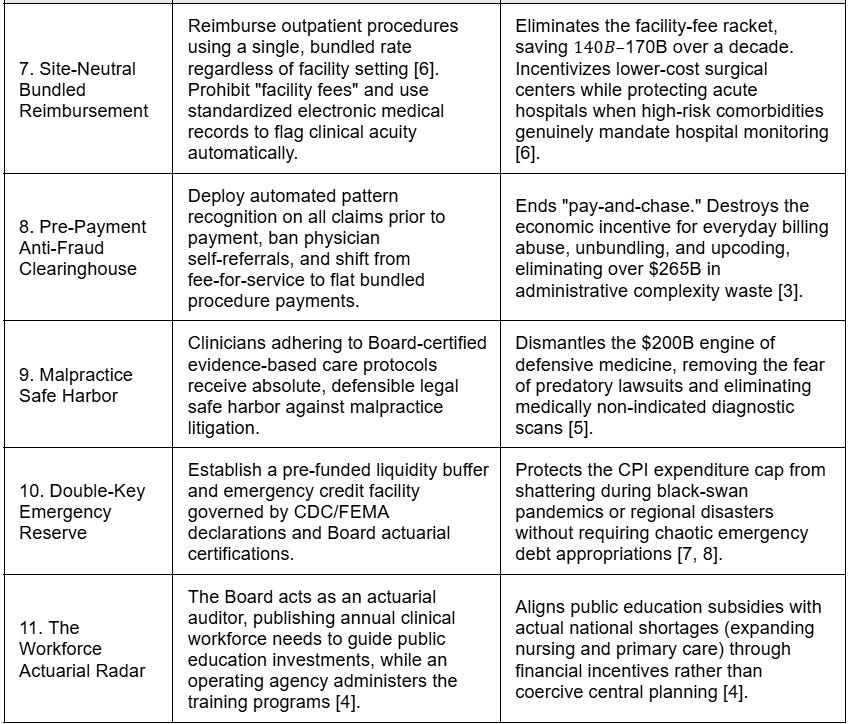
Overview of the Operational Architecture
To make this governance structure functional, the enabling statute must resolve the core operational flashpoints that sink traditional reforms: corporate liability, state financing, uncompensated care, rural access, and fraud.
1. Decoupling Healthcare from Corporate Headcount
The current model of employer-sponsored insurance (ESI) acts as an aggressive, regressive “head tax” on human labor. In 2024, American employers paid an average of over $17,000 per worker for family coverage [9]. That is a fixed, unavoidable liability that increases by 6% to 8% annually, regardless of whether the business turns a profit or loses money. It distorts hiring, encourages companies to cap worker hours below 30 per week to evade ACA mandates, and saddles human resources departments with managing complex private insurance networks.
I propose severing healthcare entirely from corporate payrolls and employment status.
Instead, the baseline health utility is funded by two clean, decoupled revenue streams:
An Earmarked Individual Health Tax: A progressive, tiered contribution that replaces existing private insurance premiums, structured so that middle-class families pay significantly less than their current premiums and deductibles.
A Flat Corporate Profit Contribution: A simple, uniform statutory percentage levied on net corporate taxable profit, paid directly into the National Health Trust.
This design neutralizes the ideological battle over corporate contributions:
The Business & Conservative Advantage: It eliminates the penalty on hiring human workers. If a business enters a lean year or suffers an economic downturn, its healthcare contribution drops in direct proportion to its profits—unlike private premiums, which increase regardless of financial performance. It relieves American companies of managing health plans, ends the regulatory gamesmanship around part-time labor, and restores parity with foreign competitors in Japan, Germany, and South Korea, whose balance sheets are never burdened with underwriting private employee health cartels.
The Progressive & Labor Advantage: Tying contributions to net profit captures the automation and productivity dividend. Under the current payroll-tax model, a software conglomerate or high-frequency trading firm generating $5 billion in profit with 300 employees contributes virtually nothing to the nation’s health pool, while a manufacturing facility or grocery chain employing 10,000 middle-class workers is crushed by healthcare costs. Taxing net corporate profit ensures that capital, high margins, and automated technology contribute their fair share to the societal baseline that keeps their customers and workforce alive.
2. The 5% Variance Collar & The Public Health Dividend
Rather than relying on easily manipulated enrollment headcounts or arbitrary federal matching formulas, each state’s baseline contribution to the National Trust is calculated directly by the Board based on actual clinical usage from the previous fiscal year.
Because providers bill the National Trust directly through a unified clearinghouse, state politicians have no ability to game the numbers, erect red-tape enrollment barriers, or purge vulnerable residents. The Board simply tallies verified clinical services delivered to the state’s population.
To protect state balance sheets, this mechanism incorporates a 5% Fiscal Variance Collar:
The Downside Collar (Max 5% Annual Increase): In any single fiscal year, regardless of how much clinical usage spiked in the previous FY due to a localized recession or plant closure, a state’s year-over-year payment increase to the National Trust is statutorily capped at a maximum of 5% over the previous year.
The Smoothing Ledger & Prosperity Catch-Up: Any excess clinical costs above that 5% cap are absorbed in real time by the National Trust’s counter-cyclical reserve. When the state’s economy recovers and tax receipts rebound, the state repays that deferred balance through modest, predictable annual adjustments (capped at an extra 1% to 2% per year) until the ledger balances.
Conversely, this creates a historic Public Health Dividend: if a state successfully lowers preventable hospitalizations and chronic disease through smart public health policies, clean infrastructure, and effective addiction prevention, its prior-year usage drops—and the state directly captures the financial savings on its balance sheet [1].
3. Drawing the Rural Health Boundary
We must confront the economic reality of rural healthcare without sentimental illusions: delivering care in low-density, remote regions inherently costs more per patient due to a lack of volume. However, the federal taxpayer should not be on the hook for propping up empty, obsolete brick-and-mortar facilities on an open-ended basis.
The enabling statute establishes a clear boundary: Clinical Parity, Not Real Estate Subsidies.
Federal Standardized Parity: The National Health Trust pays for care delivered to individuals, not empty hospital beds. A procedure, imaging study, or emergency stabilization is reimbursed at the exact same standardized bundled rate regardless of whether it occurs in rural Wyoming or suburban Chicago.
The Infrastructure Gap is a State Responsibility: If keeping a low-volume, 25-bed acute inpatient hospital open in a remote county costs 40% more to operate per encounter, the federal system will not bridge that operational deficit.
Local Choice Requires Local Capital: If a state legislature or county decides that preserving an acute-care inpatient facility is vital to their local economy, that state must fund the supplemental capital and operating difference out of state revenues.
This policy ends the federal “Critical Access Hospital” shell game that uses inflated cost-plus reimbursements to delay necessary reorganization. It forces states and rural health operators to modernize: converting unsustainable inpatient facilities into high-efficiency Urgent Care and Emergency Stabilization Centers, expanding telemedicine networks, and funding rapid regional transport hubs.
4. The Death of the “Charity Care” Shell Game
In HEA-002, I deconstructed how “charity care” and uncompensated care pools function as an accounting illusion—a loss-leader that hospital conglomerates use to defend their tax-exempt non-profit statuses while quietly shifting bad debt onto privately insured patients through inflated pricing.
The National Health Trust ends this charade. By establishing universal baseline coverage, uncompensated emergency care is permanently eradicated [7].
The Trust absorbs the tens of billions of dollars currently fragmented across federal Disproportionate Share Hospital (DSH) subsidies, local tax levies, and state uncompensated care pools, rolling them directly into the national fee schedule. When an uninsured patient walks into an emergency department, the hospital is no longer forced to absorb an uncollectible bill or deploy predatory collection agencies; it bills the Trust and receives prompt, standardized reimbursement. We replace bad-debt write-offs with guaranteed, auditable operating revenue.
5. Combating the Everyday-ness of Healthcare Fraud
Fraud in American medicine is rarely a criminal operating out of a back alley; it is the normalized, daily business model of the status quo. It is hospital billing departments systematically upcoding 15-minute visits, clinics unbundling single procedures into multiple line items, and physicians ordering non-indicated scans at imaging centers in which they hold personal financial equity. In many states, this behavior is quietly shielded by local medical boards and political leaders beholden to healthcare donors.
To understand why everyday fraud thrives, consider an auto mechanic. If you bring your car in for a minor brake squeak, and the mechanic gets paid for every single bolt they touch, every test they run, and every replacement part they invent, you leave with a $3,000 bill for a rebuilt transmission and twelve diagnostic fees.
That is Fee-for-Service medicine. It pays providers for activity, not recovery. The more needles they stick, the more non-indicated CT scans they order, and the more days you stay in a bed, the more revenue they extract. If a physician cures your condition on Day One with a generic prescription and lifestyle advice, they earn almost nothing. The system actively rewards complication, waste, and repeat business.
Moving to Bundled Flat-Rate Care flips the economic incentive completely. Think of it like a Fixed Warranty Repair. The Trust pays the hospital a single, fair, all-inclusive price to repair your hernia or manage your diabetes for the year. If the hospital orders six unnecessary scans or pads the invoice with phantom supplies, the hospital eats the cost, not the patient and not the taxpayer. The moment you pay a flat rate for a completed clinical repair, the financial incentive to commit everyday billing fraud evaporates.
To shut down the remaining systemic abuse, the Governance Firewall enforces four structural controls:
Pre-Payment Algorithmic Adjudication (The Credit Card Model): We permanently end the practice of “pay-and-chase.” Credit card networks process hundreds of millions of daily transactions, declining anomalous charges in milliseconds. Because every clinical claim in the nation flows through a single, unified clearinghouse, the Board deploys modern pattern recognition prior to payment. Billing for impossible patient hours (e.g., 36 hours of care in a 24-hour day) or procedures that violate clinical logic is rejected instantly before a dime leaves the Trust [3].
The Anti-Self-Referral Wall: The statute closes Stark Law loopholes: clinicians are legally barred from holding equity stakes or receiving financial kickbacks from any diagnostic lab, imaging center, or physical therapy clinic to which they refer patients. Ordering an unnecessary MRI will no longer pad a doctor’s personal retirement portfolio.
Double-Blind Algorithmic Audits (Math Over Politics): To ensure the audit function is never weaponized by partisan state politicians looking to discredit the system, clinical auditing is initiated strictly by automated statistical anomaly triggers (>3 standard deviations from national peer medians). Before an investigation begins, patient charts are reviewed by an independent panel of practicing physicians with the doctor’s name, facility logo, and state identity completely blinded. Math drives the audit, entirely removing political discretion.
The 15-Year Independent Comptroller General: Enforcement is stripped away from cozy state medical licensing boards and placed under an independent Trust Inspector General appointed to a single, non-renewable 15-year statutory term (modeled after the U.S. Comptroller General at the GAO), removable only by a two-thirds supermajority of Congress. The Comptroller holds the administrative power to immediately freeze clearinghouse billing privileges for any provider ring demonstrating verified fraud. Without the ability to bill the National Trust, corrupt providers face immediate insolvency, rendering local political protection worthless.
6. Defending the CPI Cap
A hard expenditure cap pegged to general CPI is essential for long-term fiscal discipline. However, rigid systems break when hit by black-swan events. If a virulent pandemic or major national disaster strikes, a hard spending cap would theoretically force hospitals to ration routine cancer surgeries and trauma care just to absorb the sudden influx of disaster victims.
To prevent this failure mode, the enabling statute establishes a dedicated, pre-funded Emergency & Pandemic Liquidity Reserve backed by a statutory credit facility.
To prevent this reserve from becoming a political slush fund or an excuse for corporate hospital bailouts, drawdowns are locked behind a mandatory Double-Key Trigger:
Key 1 (Epidemiological / Disaster Declaration): A formal, data-verified emergency declaration issued by the CDC or FEMA; and
Key 2 (Actuarial Certification): A binding supermajority certification by the independent Federal Healthcare Board confirming that regional or national clinical capacity has exceeded 110% of baseline operating volume.
Disbursements from this reserve are structured as contingent operating advances. Once the certified emergency concludes, all unexpended funds are automatically reclaimed by the Trust, and expenditures are subjected to an immediate mandatory audit by the Board’s Inspector General. This provides the system with the liquidity needed to survive catastrophes without breaking the CPI cost cap or triggering chaotic, unvetted emergency spending bills from Congress [7, 8].
Baseline Utility vs. Private Market Insurance
Opponents will inevitably attack this proposal by claiming that an independent board creates an unaccountable bureaucracy rationing your care.
To protect against overreach, the enabling statute draws an ironclad line between the Baseline Public Shield and the Commercial Supplemental Market:
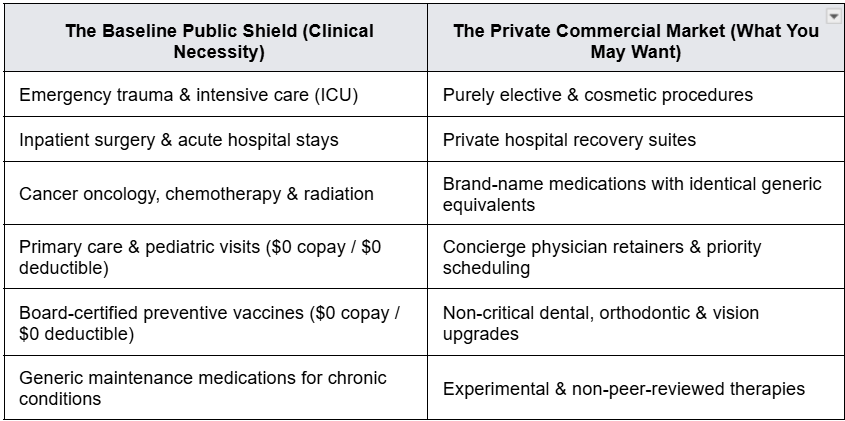
The Three Big Wins for the American Middle Class
To succeed, this architecture cannot read like an abstract policy dissertation. The average citizen must immediately understand how this model directly improves their life.
The Federal Healthcare Board is not a massive new regulatory agency dictating medical choices. Think of it like a public utility commission. Instead of regulating electricity or water, this Board has one clear mandate: keep healthcare costs from growing faster than your paycheck, make sure the system never goes broke, and ensure the medical technology components actually communicate.
For the American voter, this governance model delivers three undeniable wins:
Win #1: You Never Lose Your Care (Universal & Portable)
Under this model, your healthcare belongs to you as an individual baseline benefit of American citizenship. It is completely severed from your employer.
If you switch jobs, get laid off during an economic downturn, take time off to care for an aging parent, or take the entrepreneurial risk of starting your own business, your health coverage does not change by a single comma. Your doctors remain your doctors. Medical bankruptcy is rendered legally obsolete [7].
Win #2: Costs Are Locked to Economic Reality (The CPI Cap)
For thirty years, working families have watched their hard-earned pay raises quietly swallowed whole by 7% annual insurance premium hikes [2].
I propose that the Board enforce an Excess-Inflation Cap: national healthcare spending growth is legally pinned to general inflation (CPI) [2]. If general inflation is 2.5%, healthcare spending cannot grow by 6%.
Coupled with an annual catastrophic out-of-pocket maximum capped at no more than $2,000 to 2,500perindividual(0 copays and $0 deductibles for primary care, preventative visits, and routine vaccines), family budgets are permanently insulated from financial ruin.
Win #3: A Middle-Class Jobs Engine (Investing in Nurses)
This is not an austerity program; it is an industrial policy for American clinical labor.
Right now, the system spends billions funding an estimated 10-to-1 ratio of administrative staff to practicing physicians [3]. By using a 20-year glide path to eliminate administrative billing friction, those dollars are not lost to the economy; they are systematically redirected into expanding front-line clinical employment.
By funding faculty salaries at community colleges and state universities, we break the training bottleneck [4]. We unleash an employment boom in high-paying, recession-proof careers: registered nurses, radiologic technologists, respiratory therapists, surgical techs, and physical therapy assistants. These are stable, middle-class jobs anchored in every zip code and rural county in the nation.
The Hard Trade-Offs
In accordance with my core principle—Solutions Are Never Perfect (Expect Compromise and Trade-Offs)—I must directly confront the friction this governance model will generate:
1. The Civic Patience for a 20-Year Generational Glide Path
We cannot flip an overnight switch on an enterprise that accounts for nearly 20% of our gross domestic product. Attempting an instant transition would trigger catastrophic economic disruptions: hospital defaults, sudden bond downgrades, and clinical walkouts.
This model demands the civic discipline of a 20-year implementation horizon. It begins modestly, pegging expenditure growth to general CPI in the early years to allow healthcare organizations to adjust their cost structures [2]. It spans a full generation of clinical training, allowing existing debt-burdened specialists to finish their careers under predictable rules while a new, debt-free generation of primary clinicians, nurses, and technicians is trained to take their place [4].
2. Defending the Solvency Gate Against the “Unholy Compromise”
Once a national baseline utility is established and solvent, the greatest long-term threat to its survival will not come from its opponents, but from its politicians.
We must anticipate the classic Washington dynamic: the political Left will face relentless pressure to turn the baseline utility into an open-ended wish list, attempting to fund everything for everyone without paying for it. Simultaneously, opportunistic factions on the political Right will offer to “compromise” on those expansions in exchange for corporate carve-outs, regulatory exemptions, and special billing loopholes for their donor networks.
That unholy compromise is precisely how public programs go bankrupt. The Left gets unfunded promises to win the next election cycle, the Right gets corporate loopholes, and the resulting complexity re-opens the floodgates for everyday billing fraud.
To protect the system from this bipartisan trap, the Governance Firewall enforces three non-negotiable rules:
Clinical Decisions Stay Outside Congress: Politicians are barred from altering the baseline formulary by floor amendment; only the Board’s independent clinical council can certify evidence-based clinical necessity. Non-essential care remains strictly in the private commercial market.
Real-Time Tax Balancing (The Day-One Rule): Under the Dollar-for-Dollar Solvency Rule, any expansion of baseline coverage must be funded on Day One with an enacted, dedicated tax adjustment. No deficit financing, no borrowing from future generations, and no CBO dynamic-scoring gimmicks.
The Anti-Carveout Rule: The Trust’s bundled, site-neutral payment rules apply universally. Any legislative attempt to grant a private vendor or hospital system a special billing exemption triggers a mandatory 60-vote procedural roadblock in the Senate [8].
If a society wants more benefits, it must openly vote to pay for them. The solvency gate remains permanently locked against backroom political horse-trading.
3. Administrative Contraction vs. Clinical Workforce Realignment
When an intentionally complex billing system is simplified, the administrative apparatus built to navigate that complexity contracts. Today, for every practicing physician in the U.S., there are an estimated 10 administrative workers, largely dedicated to processing claims, chasing prior authorizations, and disputing denials [3]. As billing rules are standardized, many of these roles will become redundant.
I must honestly acknowledge the economic impact this transition will have on those workers. This model mandates dedicated retraining and workforce realignment funding to help displaced administrative professionals transition into healthcare informatics, care coordination, or front-line clinical support roles.
Furthermore, this transitions private health insurers into a standardized administrative role. Operating under a unified national fee schedule, private insurers will no longer compete on who can build the most restrictive doctor network or deny the most claims. They will compete strictly on customer service, care management efficiency, and supplemental benefit coverage.
4. The Civic Pact: Healthcare as an Essential Utility
The libertarian argument that young, healthy individuals should have the “freedom” to opt out of the system if they choose to take the risk is an actuarial fantasy. When an uninsured 25-year-old suffers a traumatic injury in an automobile accident, the trauma center does not leave them on the pavement. They are treated, and the $250,000 cost is quietly passed on to the rest of the community through inflated private premiums and local tax subsidies.
I propose reframing how we view this civic contribution. Think of the government not as an unaccountable tax sinkhole, but as a national buying club. Citizens pay an aligned, transparent contribution, and in return, they receive a guaranteed, tangible product: an unbreakable baseline health shield. You cannot opt out of the financial pool while retaining the implicit guarantee that American society will mobilize hundreds of thousands of dollars in emergency trauma care to save your life. Everyone contributes, because every citizen is protected.
The Path Forward
American healthcare does not suffer from a lack of medical brilliance, compassionate nurses, or advanced technology. It suffers from an utter absence of operational governance. We have allowed the health of our citizens to be governed by the political incentives of the next campaign cycle and the financial incentives of an uncoordinated cartel.
Ultimately, the reality check remains absolute: we cannot provide what we cannot fund.
By removing healthcare from political operating ledgers, erecting an independent Federal Healthcare Board, enforcing a CPI expenditure cap, decoupling corporate overhead from human employment, holding states accountable through audited usage, and locking in a procedural firewall, we can finally give this nation the durable, predictable infrastructure it deserves.
We can end the national tragedy of medical bankruptcy, protect family paychecks, and unleash an unprecedented era of middle-class clinical job creation.
As always, treat this publication like a professional working group. I want to hear your critical operational assessments:
Does creating an independent governing board with staggered terms provide enough political insulation, or does it leave too much power in the hands of appointed governors?
Is a 20-year generational glide path realistic for hospitals, universities, and community colleges to adjust their staffing pipelines?
How would your local hospital system adapt if outpatient surgery fees were made site-neutral tomorrow?
Add your professional and personal expertise to the discussion. Comments are moderated strictly for substance and mutual respect. Leave the bumper stickers at the door.
Next week, we turn to the human engine of the system. In HEA-004: The Workforce Transition, I will examine the mechanics of the 20-year labor transition: how we break the medical residency training bottleneck, fund nursing faculty pipelines through community colleges, and convert administrative staff into front-line allied health professionals.
Let’s stop shouting and start solving. Welcome to Really Independent.