

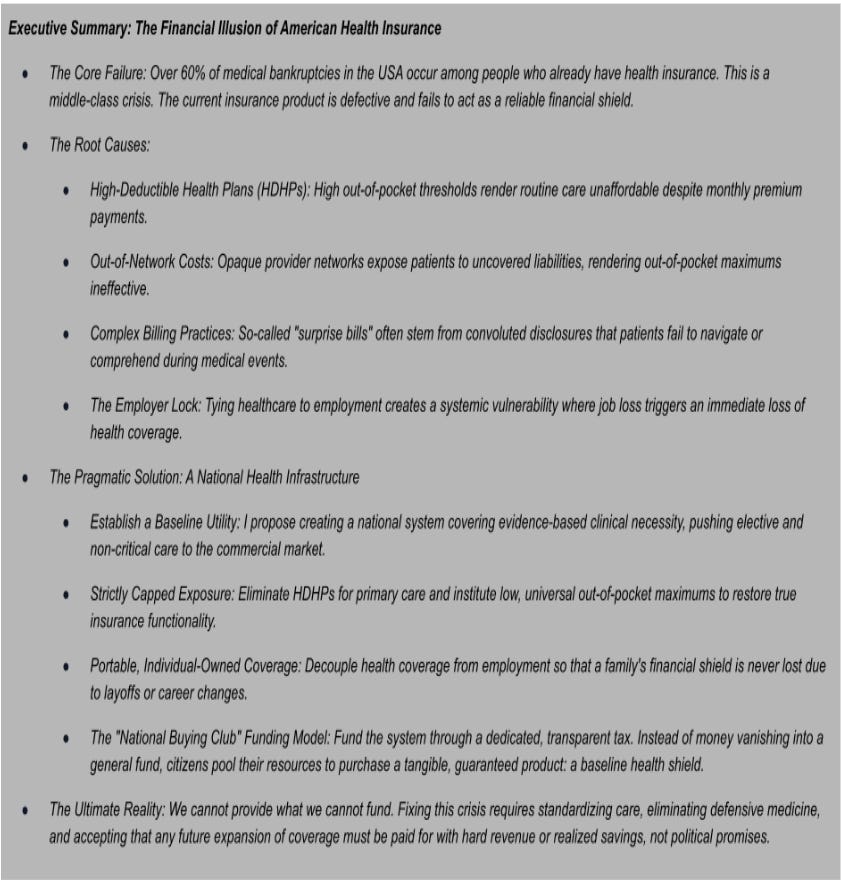

In last week’s post (HEA-001), I reviewed the macro economics of American healthcare. I established that the five-trillion-dollar machine is suffering from runaway inflation, driven by consolidated market monopolies and opaque pricing structures, and I laid out the enterprise mechanisms required to freeze the cost curve.
Today, I am moving from the national balance sheet down to your kitchen table. I am taking on Failure #2: Medical Debt and Family Budget Devastation.
If you have health insurance through your employer, you probably think you are safe from this crisis. You are not.
When it comes to protecting American families from financial ruin, we accept a defective product every single day. We are told that holding a plastic health insurance card means we are “covered.” But the math tells a completely different story.
The defining healthcare crisis of our time is about the insured. It is about dual-income, responsible, middle-class families who pay their premiums every month, only to be wiped out by a single emergency room visit.
An insurance product that fails to protect you from financial ruin when you actually get sick is not insurance. It is a financial illusion. Before designing a functional system, I must audit why the current model leaves millions of fully insured working families exposed to collections agencies, and how to re-engineer coverage into an ironclad financial shield.
Operating Principles Applied
As I established in my publication charter (About Really Independent / INT-000), I evaluate this crisis against specific principles:
Outcomes Over Methods: A pragmatist judges a tool by its results. If the primary purpose of health insurance is to pool risk and prevent individual financial ruin, and it currently fails to do so for millions of premium-paying Americans, the mechanism is broken and must be replaced.
Freedom Requires Accountability: Individual liberty is foundational, but true freedom cannot exist when a family is trapped in a job they hate simply to keep their insulin affordable. Furthermore, responsible households who budget carefully should not be wiped out by a single surprise out-of-network billing code.
Baseline Facts: The Crisis of the Insured
Before proposing solutions, I must establish the truth based upon primary source, non-partisan data. The data demonstrates that medical debt is a mainstream, middle-class reality, driven by systemic design flaws.
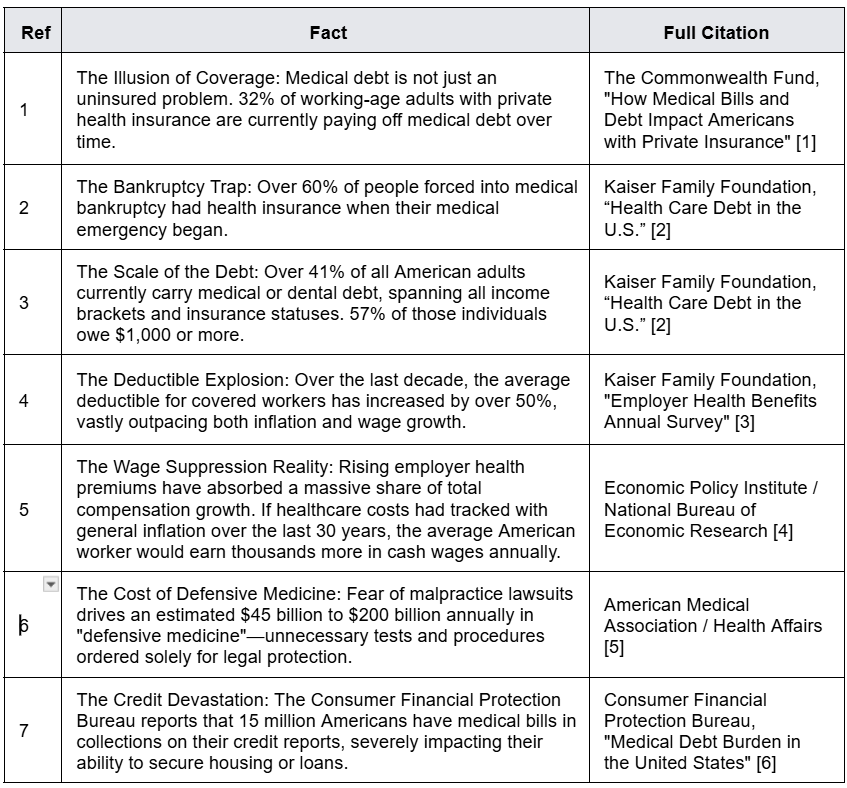
Deconstructing the Problem
How did we get to a place where a fully insured, dual income middle class family can be bankrupted by a single appendectomy?
The devastation of the family budget is driven by four specific structural flaws in how we define “insurance”:
1. The “Underinsured” Epidemic & The Deductible Trap
To keep employer premiums from exploding even faster than they already are, insurance companies have spent the last two decades quietly shifting the cost burden directly onto the patient. They did this by mainstreaming the High-Deductible Health Plan (HDHP). Today, it is common for a family to have a $6,000 to $8,000 annual deductible. For the majority of Americans, who do not have $1,000 in liquid emergency savings, this high out-of-pocket threshold renders routine care unaffordable despite monthly premium payments.
2. Out-of-Network Costs
Even if a family manages to scrape together the cash to hit their deductible, the financial shield is full of holes. A patient may go to an in-network hospital, but the anesthesiologist or radiologist who treats them is contracted by an out-of-network private equity firm. The insurance company denies the claim, exposing the patient to uncovered liabilities and rendering the “out-of-pocket maximum” contract useless.
3. Complex Billing Practices
So-called “surprise bills” often stem from convoluted disclosures. While a provider may technically disclose their out-of-network status in a stack of admission paperwork, the sheer complexity of medical billing makes it nearly impossible for a patient to comprehend or navigate these liabilities during a stressful medical event.
4. The Employer Lock & Wage Suppression
Because we accidentally chained healthcare to employment during WWII wage freezes, your family’s financial shield is tied to your HR department. If you get laid off during an economic downturn, which is exactly when stress-induced health events peak, you lose your coverage. Furthermore, this system suppresses your wages. As the Economic Policy Institute has documented, employer healthcare benefit costs have grown at more than double the rate of workers’ cash wages [4]. When your health premium goes up 8%, your 4% annual raise is quietly erased to cover the spread.
Actionable Solutions: The National Health Infrastructure
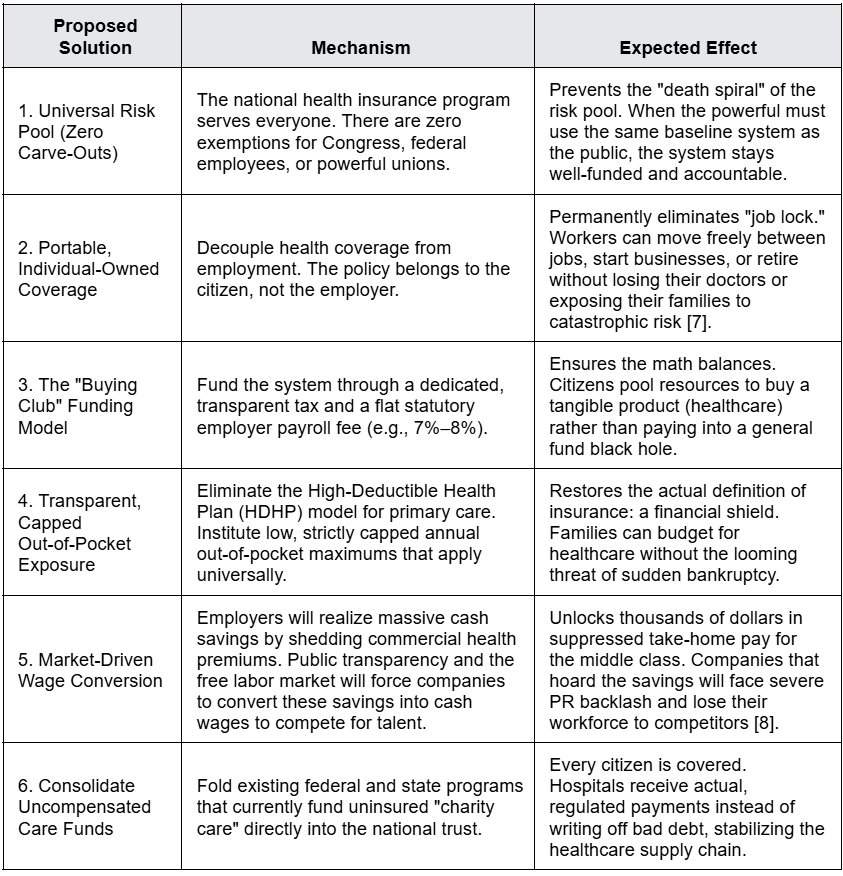
Fixing this does not require a Marxist revolution, nor does it require surrendering to the insurance lobby. It requires re-engineering the risk pool into a National Health Utility model that actually functions as insurance.
Here is the solution matrix I propose to render medical bankruptcy legally obsolete:
Drawing the Line: Owning the Two-Tiered Reality
If we as a nation are going to eradicate medical debt, we have to be honest about what a national health system can actually afford to cover. The progressive extreme demands that a national system cover absolutely everything for free. The conservative extreme demands we change nothing. Both are recipes for financial ruin.
To make this work, I draw a hard, pragmatic line between the Baseline Utility and the Commercial Market.
Critics will immediately point out that this creates a “two-tiered healthcare system.” My response is simple: We already have a multi-tiered system today, and the bottom tier is bankruptcy. A national system that addresses the vast majority of the nation’s health requirements without bankrupting its citizens is an enormous upgrade.
The Baseline Utility (The National Trust): The national system acts as the country’s clinical infrastructure. It covers evidence-based clinical necessity: emergency trauma, cancer treatments, chronic disease management, maternal health, and preventative care. It features a strict, low out-of-pocket maximum. This is what eradicates medical bankruptcy. You will never lose your house because you had a heart attack.
The Commercial Market (Private Supplemental Insurance): The national system will not pay for defensive medicine, luxury amenities, experimental therapies, non-critical lifestyle drugs, or elective procedures. If you want a private hospital suite, a brand-name drug when a generic is available, or concierge access, you are free to have it. If you have a generous employer or a strong union that wants to provide these perks, they can. But those upgrades must be purchased in the private, supplemental commercial market.
To enforce this boundary, the Baseline Utility must aggressively integrate standardized, data-driven clinical care protocols. This does not destroy the medical profession; it modernizes the guild. By standardizing the 80% of routine care, the system empowers advanced practice providers (like Nurse Practitioners and Physician Assistants) to handle the baseline. This frees up highly trained physicians to do what they actually went to school for: solving complex, atypical medical mysteries.
To maintain integrity, I propose an independent, patient-initiated appeals process, separate from the clinical providers, to review edge cases and ensure patients are not abandoned by an algorithm.
Crucially, this standardization is also the key to solving the malpractice crisis. The American Medical Association estimates that fear of lawsuits drives up to $200 billion annually in unnecessary “defensive medicine” [5]. When providers follow these standardized national protocols, they are granted absolute, defensible legal safe harbor. By removing the ambiguity of “artisan” medicine, this drastically reduces human error, eliminates the need for doctors to order unnecessary scans just to protect themselves, and drives down legal liability across the entire national system.
Canary in the Coal Mine: Charity Care and Bad Debt
While the focus of this post is the insured middle class (majority of voters), I must address the elephant in the room: the uninsured.
If a critical system relies on charity to perform its primary function, that is a massive red flag. Why is charity required for citizens to receive basic, required healthcare?
Under this national model, the uninsured do not just disappear, they become covered participants in the Baseline Utility. The billions of dollars currently spent by federal and state governments to subsidize “uncompensated care” and hospital bad debt are folded directly into the National Trust. For a hospital CFO, receiving a standardized national payment for a patient is better than writing off the visit as a total loss. Health outcomes improve, hospital balance sheets stabilize, and the “charity” red flag is permanently resolved.
The Hard Trade-Offs
Nothing in life is free and we should confront that directly on healthcare. As a nation, we owe it to ourselves to actually design a sustainable healthcare system that works without the interference of politics and budget theater in Washington DC.
1. The Visibility of the Cost
Right now, the true cost of healthcare is hidden from the American worker. Your employer pays the bulk of the premium invisibly, suppressing your cash wages to do so. Under this new model, the cost becomes highly visible: a transparent, income-scaled premium paid by the family, alongside a transparent payroll fee. Many will experience “sticker shock” when they see the true cost of their care, even if their overall financial exposure drops massively due to the elimination of deductibles and the return of suppressed wages.
2. Accepting the Limits of the Public Ledger (The Expansion Brake)
I must be direct: the national plan will inevitably be expected to expand over time. The political Left will demand it. However, any expansion of benefits must be strictly tied to hard math. The system can only expand if it is funded by new, dedicated revenues (taxes/fees) or already realized cost savings, not hopeful projections. The Left gets a path to expansion; the Right gets ironclad fiscal restraint. We cannot subsidize the system with debt.
3. The Administrative Job Contraction & Repurposing Private Insurance
When simplifying a fractured, intentionally complex system, the administrative roles built to navigate that complexity will inevitably contract. Today, for every practicing physician in the U.S., there are an estimated 10 administrative staff members, largely dedicated to navigating the complex billing and claims process [9]. As the rules change, many of these roles will become obsolete.
I must honestly acknowledge the economic impact this transition will have on that workforce. This means establishing dedicated job re-training and workforce realignment programs to help displaced administrative professionals transition into new sectors or clinical support roles. Furthermore, this transitions private insurers into a standardized administrative role. Operating under a unified, national fee schedule, private insurers will no longer compete on who can build the most restrictive network or deny the most claims. They will compete on customer service, care management, and supplemental coverage.
4. The Patience for a Multi-Year Glide Path
We cannot flip a switch on a five-trillion-dollar industry overnight. Attempting to do so would trigger an economic collapse and disrupt patient care nationally. We must start modestly. This requires a long-term implementation strategy where an accountable Federal Health Board architects, tests, and phases in these revisions and efficiencies over a multi-year glide path.
5. Government as a “Buying Club”
The conservative extreme argues that young, healthy individuals should have the “freedom” to opt out of the system if they are willing to take the risk. In a mature republic, this is an actuarial fantasy. When an uninsured 25-year-old gets into a catastrophic car accident, the hospital does not leave them on the curb. They are treated, and the $200,000 bill is quietly passed on to the rest of us through higher premiums and hospital markups.
I propose reframing how we view this contribution. Think of the government not as a black hole for taxes, but as a massive national buying club. You are paying a specific, aligned tax, and in return, you are purchasing a tangible, guaranteed product: a baseline health shield. You cannot opt out of the financial pool while retaining the implicit guarantee that American society will save your life in an emergency. Everyone contributes, because every citizen is protected.
The Path Forward
Ultimately, the message of this entire series comes down to a simple mathematical reality: we cannot provide what we cannot fund.
Funding a national healthcare system requires an enormous set of trade-offs. To make this work, we need two things from the American public: we need people to contribute financially, and we need them to consume healthcare more judiciously. That is how we ultimately fix the issue.
We cannot claim to be the greatest economy in the world while fully insured citizens are setting up GoFundMe pages to pay for chemotherapy. By decoupling health coverage from employment, establishing a transparent, individual owned policy, and capping out-of-pocket exposure, we can build a sustainable financial shield. We can eliminate the fear of medical bankruptcy and return true labor mobility to the American worker.
As always, treat this like a professional working group. I want to hear your risk comments and opinions. I’ve written a lot here.
If your health insurance was permanently decoupled from your employer and belonged to you, how would that change your career choices, entrepreneurial risks, or retirement timeline?
Does a transparent, aligned tax contribution with zero deductibles feel more or less secure to you than your current employer-sponsored plan?
Add your professional and life experience to the discussion. Comments are moderated strictly for substance and mutual respect. Leave the bumper stickers at the door.
Next week, I tackle the third rail of healthcare reform. In HEA-003: The Governance Firewall, I will audit how an independent Federal Healthcare Board actually works in practice to manage this multi-year glide path, how to define its operational limits, and how to lock in a 60% congressional firewall to prevent politicians from ever raiding the trust fund.
Let’s stop shouting and start solving. Welcome to Really Independent.
Corroborating Evidence & Source References
[1] The Commonwealth Fund: How Medical Bills and Debt Impact Americans with Private Insurance
[2] Kaiser Family Foundation: Health Care Debt in the U.S.: The Hidden Crisis
[3] Kaiser Family Foundation: Employer Health Benefits Annual Survey (Deductible Growth vs. Wages)
[4] Economic Policy Institute / National Bureau of Economic Research: The Hidden Cost of Healthcare on Worker Compensation
[5] Health Affairs / American Medical Association: The Cost of Defensive Medicine and Malpractice Liability
[6] Consumer Financial Protection Bureau: Medical Debt Burden in the United States
[7] Congressional Budget Office: Options for Universal Health Care Coverage
[8] Congressional Research Service: Compensation and Benefits Under Collective Bargaining Agreements
[9] Health Affairs: The Growth of Administrative Staff vs. Physicians in U.S. Healthcare